Every passage out of Cairns - north to Thursday Island and the Torres Strait, east into the Coral Sea, north-west to PNG, or further to Indonesia and the South Pacific - puts a yacht beyond the reach of professional repair for days at a stretch. Steering failure at sea is not an inconvenience that can be managed from a marina berth. The passages available from Cairns offer few anchorages capable of providing shelter for below-waterline work, and the harbours in between range from basic to nonexistent for steering repairs. That makes the pre-departure inspection the only point in the voyage where you have full access, full tools, and time to fix what you find.
Why Steering Failure Offshore Is Different
Ocean Navigator has documented the problem in blunt terms:
Every year a surprising number of offshore boats are abandoned or lost because of steering problems - once offshore, it can be very difficult or impossible to make steering repairs.Ocean Navigator
The passages available from Cairns amplify this risk. Torres Strait transit is concentrated, tidal, and logistically demanding. The PNG coastline offers limited infrastructure. Indonesian passages cross stretches of open water where you will not see another vessel for days. Any repair attempted underway - re-rigging a cable run, bleeding a hydraulic system in a seaway, fashioning a jury rig from whatever is aboard - happens without bench access, in motion, often in darkness or deteriorating conditions.
Queensland maritime safety legislation requires operational steering on vessels operating offshore. The Transport Operations (Marine Safety) Act 1994 is the governing framework. The specifics of what constitutes a compliant backup system are interpreted and updated periodically, so check with Maritime Safety Queensland for current requirements. What is consistent is that offshore passage yachts require a backup operable independently of the primary system.
The practical implication: steering system inspection should happen at the start of the Cairns refit sequence, before you have committed to a departure date. Finding a seized emergency tiller fitting or a corroded quadrant late in the refit leaves no room to manoeuvre.

Identifying Your Steering System Type
Inspection method depends entirely on what system is fitted. The three types found on passage yachts transiting Cairns are cable-and-quadrant, hydraulic ram, and torque tube. Each has distinct failure modes and a different inspection approach.
| System type | Typical vessels | Main failure mode | Serviceable in Cairns | Critical spares |
|---|---|---|---|---|
| Cable and quadrant | Most production yachts 28-50ft | Cable jumping off sheave; broken strands | Yes - cable, sheaves, quadrants available | Full cable run; spare sheaves |
| Hydraulic ram (SeaStar, now Dometic Marine) | Cruising yachts 35-55ft | Seal degradation; air ingestion; contaminated fluid | Partly - standard seals and fluid; specialised pump units may need factory service | Proprietary fluid; bleed kit; helm cylinder seals |
| Torque tube / rod (Whitlock, now Lewmar) | Swan, Oyster, quality offshore production yachts | Worn splined couplings | Rarely - specialist knowledge required | Spare splined couplings - essential |
If you are unsure which system is fitted, follow the steering cable from the pedestal. Cable-and-quadrant systems terminate at a curved metal arc clamped to the top of the rudder stock, accessible through the aft locker. Hydraulic systems have hose runs rather than cable. Torque tube systems use a stainless rod or tube through the vessel's interior, with no cable visible.
Cable and Quadrant: The Full Inspection
Cable-and-quadrant is the most common arrangement on offshore yachts, and despite its familiarity, it has failure modes that visual inspection alone will not reveal.
The rag test
Run a soft cotton cloth the full length of each cable - port and starboard - in both directions, with light grip, slowly, from pedestal to quadrant. A broken strand (called a meat hook) will snag the fabric. These broken strands are invisible to visual inspection on stainless wire unless you happen to be looking at the exact location in strong directional light. Even one broken strand in a 7x19 construction cable is grounds for replacement before an offshore passage. The rag test is not optional.
Cable tension
The most common steering failure at sea is not cable fracture - it is cable jumping off a sheave because of insufficient tension. Cruising World and Ocean Navigator both cite this as the leading cause. With the helm locked at centre, you should not be able to move the quadrant by hand. If you can, the cable will jump a sheave in a seaway when load transfers suddenly. Test with the helm hard at centre, not in a relaxed mid-position.
Sheaves
Inspect every sheave in the cable run. The groove must match the cable diameter - check with calipers or a cable gauge. An undersized groove forces the cable to ride high on the sheave edge and accelerates strand wear at that exact point. Even a correctly sized sheave develops groove wear over time, with the same effect. Turn each sheave by hand to confirm free rotation. A sheave that does not turn freely creates a localised wear point and transmits shock loads as an abrupt stop rather than a smooth bearing surface.
The pedestal chain
Inside the wheel pedestal, a section of roller chain connects the steering sprocket to the cable run on most cable-steered yachts. This chain is a commonly overlooked inspection point because it is out of sight inside the pedestal base. Remove the pedestal cover and inspect every link for stretching, cracking, or corrosion. Lubricate it thoroughly. A dry or stretched pedestal chain produces helm feedback symptoms - vagueness, dead zones, uneven resistance - that are easily mistaken for cable or quadrant problems, sending you looking in the wrong place.
Quadrant keyway and stock alignment
Examine the alignment marks scribed on the quadrant and the rudder stock. If the marks are offset, the quadrant has slipped on the stock - which means it has been progressively shearing the keyway. A slipped quadrant is a haulout item. You cannot assess the full extent of rudder stock damage without getting the boat out of the water. If you see offset marks, do not defer this to the next season.
Also look for white powdery oxidation at the interface between an aluminium quadrant and a stainless steel rudder stock. This is active galvanic corrosion. Dissimilar metals in warm, salt-laden tropical water corrode faster than temperate-climate maintenance guides describe. Industry practice is to remove the quadrant for a full corrosion inspection on a regular cycle in tropical conditions - ask a Cairns marine engineer for the current recommended interval.
Hydraulic Steering: Fluid, Air, and the Bleed Sequence
Fluid condition
SeaStar (now sold as Dometic Marine) hydraulic steering systems use a specified steering fluid with proprietary additives - not automotive brake fluid, and not an unlisted hydraulic oil substitute. Using the wrong fluid causes seal degradation, foaming, and moisture absorption leading to internal corrosion. Confirm the correct fluid specification for your exact system with the supplier or manufacturer before topping up or flushing. The fluid should be clear. Brown discolouration indicates contamination and requires a full flush and bleed before passage. Keep a sample in a clean glass jar and hold it to light; any cloudiness, suspended particles, or brownish tint warrants a fluid change.
Air in the system
Air in a hydraulic system feels like sponginess at the wheel or a dead zone in the mid-rotation range. It develops from micro-leaks at hose fittings that may draw air on the return stroke without showing visible fluid loss externally. A simple helm-to-helm purge does not fully displace air from the ends of the cylinder ram, where it tends to accumulate. The correct bleed sequence is:
- Turn the helm to full lock in one direction and hold it there.
- Remove the bleed screw or top the helm cylinder reservoir to the correct level at that position.
- Turn to full lock in the opposite direction and hold.
- Top up the reservoir again at this full-lock position.
- Return to centre and do a final top-up at the helm reservoir to the specified level.
The sequence above is a general guide. For SeaStar and Dometic Marine systems, the manufacturer's current service manual specifies the exact bleed procedure for your model - many installations use dedicated cylinder bleed fittings rather than helm reservoir top-ups alone, and the steps vary between system generations. Follow the manufacturer's instructions for your specific system.
If the system still feels spongy after bleeding, repeat the procedure. Persistent air indicates an ongoing micro-leak that must be traced and fixed before departure.
Hose inspection
Inspect the full hydraulic hose run for cracking, UV hardening, or abrasion damage at any point where hose passes through a bulkhead or over a fitting edge. Squeeze the hose by hand - it should flex without crackling. Tropical UV exposure and heat accelerate rubber compound degradation. Any hose showing surface crazing should be replaced regardless of age.
Rudder Stock, Bearings, and the Stuffing Box
Have someone stand below or in the aft locker while you work the helm hard from side to side. What to look and feel for:
- Lateral movement in the rudder stock at any bearing point - even small play that grows under helm load indicates a worn bearing requiring attention before passage
- The stuffing box dripping faster than a slow occasional weep - a steady drip is not acceptable for offshore use and must be repacked or replaced
- Grinding, clicking, or uneven resistance through the helm arc - these point to bearing wear, not cable tension issues
- On composite rudder stocks, any flexing or deflection at the mechanical bearing interface under helm load - this is a serious indicator of delamination and requires specialist assessment
Rudder bearing play is a haulout assessment. If you detect meaningful movement in the stock during this test, factor a haulout into the Cairns refit timeline before departure.

Emergency Steering: What the Regulations Actually Require
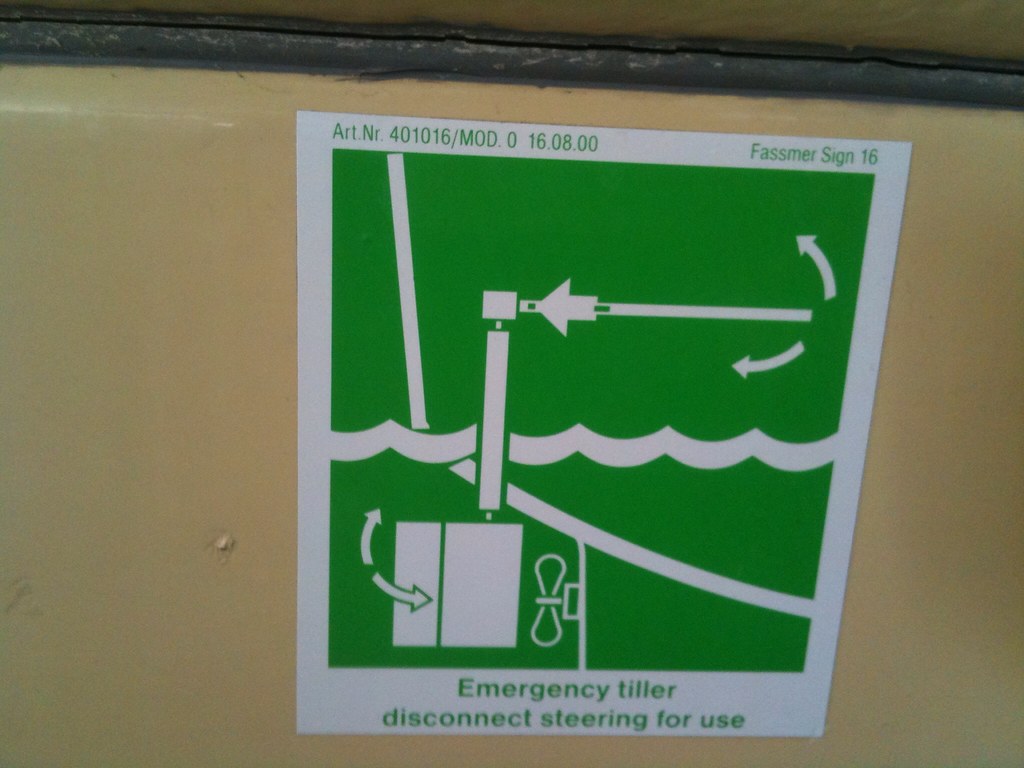
World Sailing Offshore Special Regulations Category 1 is widely referenced as an offshore preparation benchmark for passages in this region, including passages to PNG, Indonesia, the Torres Strait, and the South Pacific - check whether the specific organized passage or race you are entering formally requires OSR compliance. Category 1 covers two distinct emergency steering provisions: an emergency tiller capable of being fitted to the rudder stock (for use when primary steering fails but the rudder remains intact), and a separate proven method of emergency steering with the rudder disabled. The practical implication for the emergency tiller provision: the tiller must be physically test-fitted and demonstrated to engage the rudder stock before departure, not simply carried aboard.
The emergency steering drill should cover more than a tiller fit-check:
- Who does what - which crew member takes the tiller, who manages sails to reduce load on the rudder
- Sheet-to-tiller self-steering as a backup in heavy weather when manual tiller steering is exhausting for a short crew
- Use of a drogue or other drag device to maintain directional stability if the rudder itself is damaged
- How to communicate a steering emergency to other vessels by radio - especially relevant on passages where traffic is sparse
Drilling this once, with the full crew, before you leave is the difference between a managed emergency and a panic. The emergency tiller test is not a paperwork exercise for an OSR checklist - it is a live skills check that must actually happen.
Tropical Queensland-Specific Concerns
Guidance from temperate-climate sailing publications is not calibrated for conditions around Cairns. The monsoon season brings sustained high humidity into sealed pedestal enclosures, corroding the roller chain, sprocket teeth, and cable termination swages in ways that dry-season inspection alone will not reveal. After a wet season in Cairns, open the pedestal and inspect the full chain and cable termination assembly before departing on any passage.
Replacement Intervals and the Haulout Decision
Hydraulic fluid should be changed on condition rather than on a fixed schedule - check colour and clarity at every annual service and before each passage. A brown or contaminated sample means a full flush and bleed now, regardless of when the last change was.
What requires the boat out of the water:
- A slipped quadrant - assessing rudder stock damage requires inspecting below the waterline
- Meaningful rudder bearing play detected during the helm movement test
- A quadrant removal for corrosion assessment in tropical conditions - removing the quadrant fully typically requires haulout access
- Any suspected delamination of a composite rudder stock
Getting the Work Done in Cairns
Schedule the steering inspection at the start of the refit sequence, not at the end. Finding a problem - a corroded quadrant, a slipped keyway, a seized emergency tiller fitting - creates downstream work that needs to be completed before final provisioning and crew briefing. If you find it in the last week before departure, you have no room.
When briefing a marine engineer, ask specifically for:
- The rag test on the full cable run, not a visual inspection only
- Removal of the pedestal cover, inspection of the roller chain, and lubrication
- A hydraulic fluid sample in a glass container for a colour check if the system is hydraulic
- A physical test-fit of the emergency tiller with documentation of the result
- A check of alignment marks on quadrant and rudder stock
If any metalwork is fitted or replaced near the binnacle compass during the steering service - a steering guard, pedestal hardware, a new support fitting - the compass deviation must be re-checked. New ferrous or magnetic material near a binnacle compass changes its deviation in ways that are not predictable without swinging the compass. Have it re-swung by a qualified adjuster before passage. For offshore navigation in areas where GPS backup may be limited, a compass with uncorrected deviation is a genuine navigational liability.
Frequently Asked Questions
Is cable-and-quadrant or hydraulic steering more reliable for offshore passages out of Cairns?
Both systems are proven for offshore use when maintained properly. Cable-and-quadrant is simpler to diagnose and repair at sea - cable, sheaves, and quadrant components are available in Cairns and can be carried as spares. Hydraulic systems add fluid management and seal inspection to the maintenance load, and proprietary components add a supply dependency. The key variable in tropical Queensland conditions is not which system you have but whether it has been inspected to the standard the conditions and the passage demand.