The Coral Sea crossing from Cairns to Vanuatu is one of the most direct offshore passages available to Australian blue-water sailors - approximately 1,250 nautical miles to Luganville on Espiritu Santo, and around 1,361 nautical miles to Port Vila on Efate. At normal cruising speeds that translates to seven to ten days at sea, fully committed. No harbours exist between the Australian coast and the Vanuatu archipelago. That single fact changes the preparation equation completely, and it is what sets this route apart from the Torres Strait run to Indonesia where bail-out options exist throughout the approach.
The Passage in Context
Two routes from Cairns to Vanuatu
Cairns skippers heading to Vanuatu have two realistic routing options. The direct Coral Sea route - exit northeast through Grafton Passage in the Great Barrier Reef, then hold a broadly northeast heading across open water to the archipelago - is the route most passage-making yachts choose during the trade wind season. It is the shorter option and the one this guide focuses on.
The alternative runs north from Cairns through the inside of the Great Barrier Reef to the Torres Strait, navigates the strait at the tip of Cape York Peninsula, then arcs northeast across the Coral Sea. It is significantly longer, adds the tidal and navigational complexity of Torres Strait planning, and suits boats also visiting Papua New Guinea or the Louisiade Archipelago en route. For a boat bound directly from Cairns to Vanuatu, the direct Coral Sea crossing is almost always the right call.
Vanuatu in the broader South Pacific circuit
For sailors on a South Pacific circuit from Queensland, Vanuatu sits at the natural far end of the Coral Sea - well positioned as an end destination or as a stepping stone east toward Fiji, Tonga, and beyond. It is also a reasonable waypoint for boats returning to Australia via New Caledonia and the Queensland coast. The passage from Cairns is long enough to demand serious offshore preparation but short enough that a well-found, well-provisioned boat can make it without ocean-passage range anxiety.
When to Leave Cairns
The southeast trade winds are the engine of this crossing. They blow reliably across the Coral Sea from roughly May through October, providing the consistent wind angle and direction that makes a northeast passage from Cairns straightforward for a prepared yacht. This is the recognised departure window, and departing within it means working with the system rather than against it.
Leaving before the trades establish firmly - before mid-May - carries real risk. The official tropical cyclone season in the Australian region runs November through April, but late-season systems can and do develop into May. A fully formed cyclone on the Coral Sea while a yacht is seven days from the nearest harbour is not a hypothetical to dismiss lightly. Any boat planning a May departure should be watching the Bureau of Meteorology's extended tropical weather forecasts as closely as the standard routing analysis.
Weather routing for a week-plus open-water commitment
Unlike a coastal passage where deteriorating weather can be waited out at anchor, a Coral Sea crossing commits the vessel to conditions that cannot be fully predicted at the outset. Good weather routing means two things: a clean departure window with established trades and no active depressions in the area, and a realistic assessment of how the pattern might evolve over the following week to ten days.
Strong surges in the southeast trade wind system can produce steep, confused sea states on the Coral Sea - short-period swells from one direction intersecting with trade wind chop from another. Waiting in Cairns for a settled, well-established trade pattern rather than departing on the first southeast breeze of the season is consistent advice from experienced Coral Sea passages.
Getting Out of Australia
Outward clearance and the zarpe
All yachts departing Australian waters for an overseas destination must complete formal outward clearance with the Australian Border Force before leaving. For Cairns-based boats, this means completing the required documentation and presenting to ABF. The document that results from this process is the zarpe - the outward clearance certificate that proves the vessel was legally checked out of Australia. Vanuatu Customs will ask to see it when officials board on arrival, and it cannot be reproduced after the fact.
Clearance is not a formality to handle on the morning of departure. Crew list preparation, vessel documentation, and the declaration of destination all require time to do correctly. The Australian Border Force website is the authoritative source for current outward clearance requirements.
Through Grafton Passage and into the Coral Sea
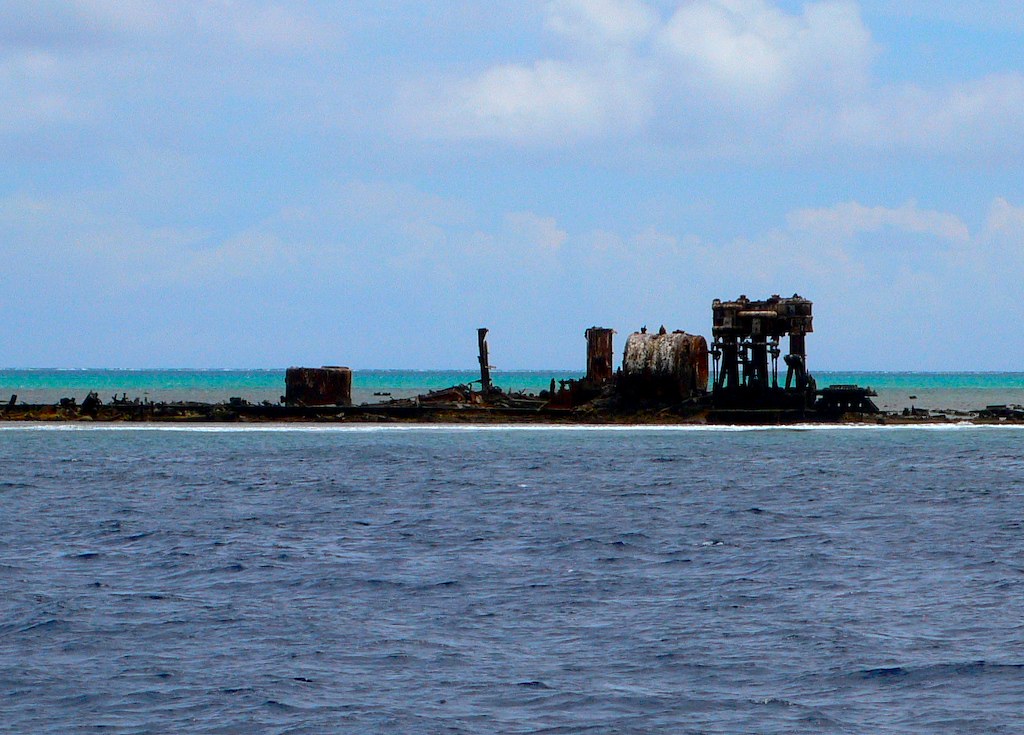
Grafton Passage, located roughly 35 nautical miles northeast of Cairns, is the designated deep-water exit through the Great Barrier Reef for yachts heading northeast. The transit from Cairns to Grafton is straightforward in daylight with chart plotter and paper charts as backup - but the approach through the reef requires attention to tide timing, current, and visibility. Once through, a yacht is in the open Coral Sea with no navigational obstacles between it and Vanuatu.
Yacht Preparation for the Coral Sea Crossing
When the nearest boatyard is a week away and there is no harbour to duck into, every mechanical and structural decision made in Cairns takes on more weight. The Coral Sea crossing is a different risk category from coastal or reef-passage sailing - a failure that would be a nuisance inshore becomes a serious problem when no assistance is reachable within days.
The systems that matter most
- Autopilot: On a crossing of this length, the autopilot carries the helm for the majority of the passage. It must be in full working order before departure. A spare drive unit or rebuild kit should be aboard if the installation allows - a failed autopilot mid-passage means hand-steering for days, which exhausts crew and degrades judgement.
- Watermaker: A functioning reverse-osmosis watermaker removes dependence on tank capacity alone. Service membranes and high-pressure pumps before the crossing. A unit that develops a fault on day three is a planning failure, not bad luck.
- Engine and fuel range: Trade wind crossings are predominantly under sail, but the engine will be needed for calms, battery charging, and harbour manoeuvring on arrival. Plan fuel capacity for the possibility of motoring a significant portion of the distance - an unlikely scenario, but one to plan for regardless.
- Rig inspection: Standing rigging, chainplates, turnbuckles, and spreader roots should be inspected by someone who can get aloft in a marina. Running rigging and sheets take heavy wear in sustained trade wind conditions and should be replaced if there is any doubt.
- Sea state readiness: Coral Sea surge conditions in strong trade periods are steep and irregular. Everything below decks that could move should be properly stowed and secured before Grafton Passage - the first days of the crossing are typically the roughest.
Beyond mechanical systems: the medical kit should be expanded for offshore distance, flares and EPIRB registration checked and current, the life raft within service date, and communications tested. SSB or satellite phone in working order before the reef is astern is not optional on a passage of this length.
Choosing Your First Port of Entry
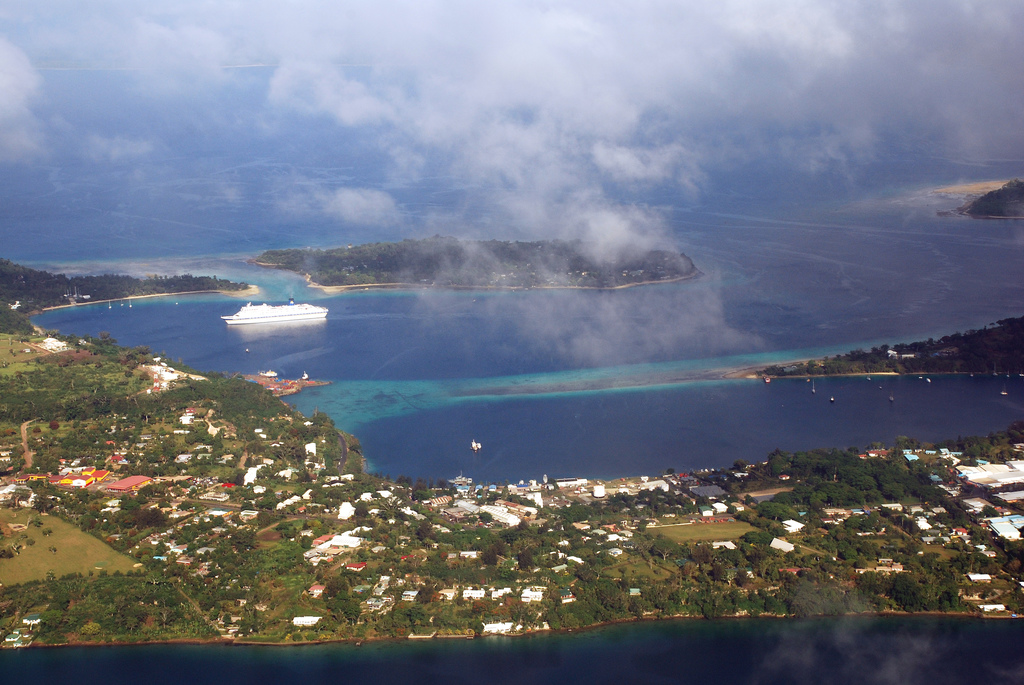
Vanuatu designates four ports of entry for visiting yachts: Port Vila on Efate, Luganville on Espiritu Santo, Lenakel on Tanna, and Sola on Vanua Lava in the Banks and Torres Group. A yacht arriving from Cairns during the southeast trade season will almost always choose between Port Vila and Luganville - the two largest, closest, and best-equipped of the four.
This choice has consequences that extend beyond the first anchorage. If a skipper intends to depart Vanuatu from Luganville rather than the entry port, that permission must be requested when clearing in - it cannot be arranged later in the trip. This practical constraint is almost never mentioned in passage-planning content, and it matters significantly for anyone planning a northern itinerary through the Banks and Torres islands.
| Factor | Port Vila (Efate) | Luganville (Espiritu Santo) |
|---|---|---|
| Distance from Cairns | Longer (around 1,361 NM) | Shorter (around 1,250 NM) |
| Facilities and services | Established marina, full boatyard services | More limited, improving |
| Provisioning | Capital city, widest range of supplies | Adequate but smaller selection |
| Onward routing | Central hub, routes north or south through island chain | Further north, better base for Banks and Torres Group |
| Departure port option | Standard international departure port | Must be requested at first clearance |
Port Vila is the default choice for most boats from Cairns - the capital city, the largest harbour, and the natural hub for provisioning and boat work. Luganville suits boats intending to spend most of their time in the northern islands and wanting to save a few days of passage time on the approach.
Arrival Procedure Step by Step
All yachts must notify Vanuatu Customs in advance of arrival by email. The notification must include the vessel name, last three ports visited, estimated time of arrival, intended port of entry, skipper details, and a complete crew and passenger list. The required lead time and current contact email for Vanuatu Customs and Inland Revenue should be confirmed directly through Vanuatu government sources before departing Cairns - both are subject to change, and arriving without having sent the notification creates complications that delay clearance.
On arrival, the sequence is fixed and must not be varied:
- Anchor at the designated quarantine buoy in the harbour and hoist the yellow Q flag immediately. No one may board or go ashore except officials until clearance is complete. Verify the current buoy position from Port Vila harbour management or a current cruising almanac before entering the harbour.
- Quarantine boards first. The inspection covers all food stores aboard - everything must be declared. Prohibited items must remain on the vessel and cannot be landed at any point during the visit.
- Customs boards after quarantine to inspect vessel documents and complete the ship's stores declaration.
- Immigration boards last to process crew and passenger documents and issue entry stamps into passports.
- Once all three officials have cleared the vessel, the Q flag comes down and normal harbour movement is permitted.
Fees and Paperwork Consolidated
Fees are charged separately by quarantine, the port authority, and immigration. The specific amounts in Vanuatu Vatu change periodically and should be verified against current information from Vanuatu Customs, the Port Vila Port Authority, and Vanuatu Immigration before departure. Carry sufficient Vatu in cash - card facilities are not reliably available on official vessels. A pet aboard triggers a higher quarantine fee than a vessel without animals. Clearing during normal business hours avoids overtime charges from customs; confirm current weekday office hours directly with Vanuatu Customs before making arrival plans.
Australian passport holders enter Vanuatu without a visa for initial stays up to a defined limit; extensions are available through Vanuatu Immigration at additional cost, up to a defined maximum stay within any twelve-month period. Check current limits and fees with Vanuatu Immigration directly before planning a long season.
Documents required on the table when officials board:
- Original Certificate of Registry and proof of ownership if requested
- Zarpe issued in Cairns by the Australian Border Force
- Completed crew list - bring multiple copies, as each agency retains one
- General Declaration form, completed in advance if possible
- Ship's stores declaration covering all food, alcohol, and tobacco aboard
- Passports for all crew and passengers
The Inter-Island Cruising Permit
Once cleared in at the port of entry, apply for the Inter-Island Cruising Permit at the same clearance appointment. Valid for a defined extended period as specified in current regulations - confirm the maximum duration with Vanuatu Customs - this permit is what allows a yacht to move freely throughout the Vanuatu archipelago without reporting to customs at every individual island. Without it, each move between islands technically requires a separate customs notification, which is impractical in a chain spread across hundreds of miles of ocean.
The clearance appointment is the only chance to declare a departure port other than the entry port. Miss it, and there is no administrative option other than returning to the entry port for international outward clearance. For a boat spending its season in the northern islands, that is several days of backtracking with no shortcut.
The permit does not replace departure formalities. When the time comes to leave Vanuatu for overseas, international outward clearance must be obtained on a weekday within defined office hours - confirm current times with Vanuatu Customs before making departure plans. Once international departure clearance is issued, the vessel must leave for overseas within a strict, defined timeframe that cannot be extended. This means the weather window and the clearance appointment must be planned together. If the forecast is not acceptable on the day clearance is issued, the clearance cannot be held - a new appointment must be made on a later date when conditions allow.
Biosecurity, Anchoring Rules, and Customs-to-Know
Biosecurity - the provisioning trap
Vanuatu biosecurity rules are strict, and a well-provisioned boat departing Cairns is exactly the kind of vessel an inspector can quickly identify. The following items are prohibited from landing from any visiting yacht:
- Fresh meat and meat products
- Live animals and birds
- Fresh fruit and vegetables
- Eggs and egg cartons or packaging
All food on board must be declared at the quarantine inspection. Prohibited items do not have to be destroyed on the spot - they must remain on the vessel for the entire visit and cannot be landed at any anchorage. Heavy penalties apply to undeclared items or items found ashore. The practical response for a boat leaving Cairns with a full fresh provisioning is straightforward: plan to consume perishables during the crossing, declare everything honestly on arrival, and provision fresh goods within Vanuatu once ashore.
Anchoring and the C.A.R.E. framework
The Code of Anchoring in Reef Environments (C.A.R.E.) guidelines are in use throughout Vanuatu and prohibit anchoring in coral. Some protected areas impose stricter rules - the Bokissa Island marine sanctuary, for example, prohibits anchoring inside a defined depth line entirely. Check current local restrictions before entering an unfamiliar bay, use sand patches only, and treat every anchoring decision in Vanuatu with the same care given to navigation in the reef.
Village anchorage fees
Many village anchorages throughout Vanuatu request a customary fee paid directly to the village chief - entirely separate from any government charge and not formally regulated. The chief or a village representative will usually make contact when a yacht anchors. Carrying small-denomination Vatu notes and treating the arrangement as a respectful negotiation rather than a formal toll reflects the custom-based land and sea tenure system that underpins access to Vanuatu's anchorages. These fees are a normal part of cruising here, not an inconvenience to be argued about.
Frequently Asked Questions
What if I want to depart Vanuatu from Luganville but I arrived at Port Vila?
Permission to depart from a port other than your entry port must be requested at the original clearance appointment - not later in the trip. If you clear in at Port Vila intending to exit from Luganville, raise this at the first appointment. If you do not, returning to your entry port for outward clearance becomes a likely requirement, with significant itinerary implications.