Every May, dozens of yachts swing at anchor in Trinity Inlet or berth along the Cairns marina wall, crews readying for offshore passages that will carry them to Vanuatu, the Solomons, Indonesia, Papua New Guinea, or through Torres Strait. Most of those boats have sat through at least one Far North Queensland wet season. Some have sat through several. The sails may look fine from the cockpit. The problem is what you find when you pull them down, spread them on concrete in full daylight, and actually look.
Why Cairns Is One of the World's Harshest UV Environments for Sailcloth
Cairns sits in a UV category that many sailors from temperate regions find hard to accept until they see the data. The city's UV index peaks at 14 - rated Extreme - in January, and the annual average is 11.9. More critically, the index exceeds the World Health Organization's sun-protection threshold of 3 for every single month of the year, including the drier, cooler months that feel mild compared to the wet season. No month gives your sails a break.
What that means in practical terms is that a sail in Cairns is never truly resting. Even when folded in a bag, ambient heat and residual UV through a marina shed roof compound the damage from months afloat. The degradation is not linear and not visible to the naked eye at first.
The distinction between thread and cloth is the key insight. Stitching breaks down faster than sailcloth because the thread is thinner, has far less material mass to absorb radiation, and sits more surface-exposed than the weave of the sail panel. In tropical conditions broadly comparable to Far North Queensland, UV-stabilised polyester stitching loses approximately half its tensile strength after two years of exposure - even when the sailcloth looks structurally sound. A sail that passes a tug-and-poke inspection at the dock can split its seams in the first rough weather after departure.
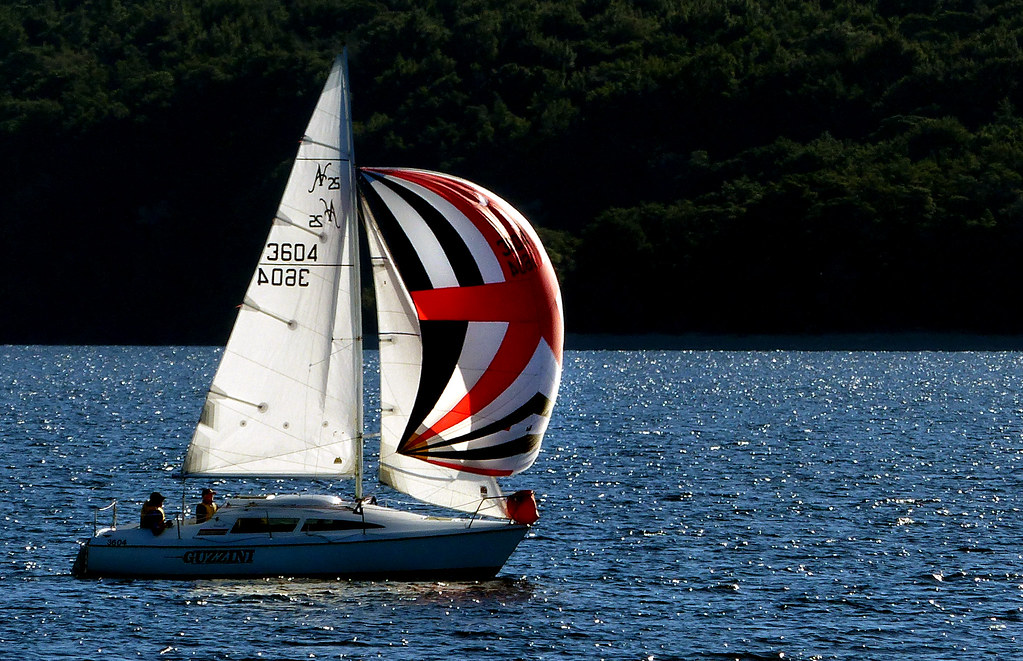
The Sail Inspection Process: Start Before You Check the Weather
A proper inspection cannot happen on the boat. Wind, rigging shadows, and the awkward angles of working aloft all prevent systematic examination. Pull every sail you plan to carry offshore.
- Wash the sails with fresh water and a mild soap solution. Saltwater crystals and biological growth hide stitching damage. Hose them thoroughly and let them dry completely before spreading - wet sailcloth masks delamination and obscures thread condition.
- Spread sails flat on a clean surface in full daylight. A tennis court, a marina car park, or a vacant concrete hardstand all work. You need full-panel visibility and strong, indirect light. Overcast days reduce glare that can wash out stitching detail.
- Work each panel from luff to leech in a systematic grid. Start at the head and move down, checking every seam and panel join. Use a bright torch held at a low angle to pick up stitching irregularities - thread that has lost tensile strength often shows fuzz or gaps before it fully breaks.
- Flex each batten pocket and load-bearing patch by hand. Stiffness and cracking at the pocket mouth are early signs of UV fatigue in the reinforcing fabric.
- Tug seams with moderate hand pressure at regular intervals along every join. Sound stitching does not move. If the seam opens even slightly under hand load, the thread has lost enough strength to fail under sail pressure in any kind of weather.
- Hold suspicious panels up to light. Pinholes and translucent patches in woven cloth indicate fibre breakdown. On laminates, look for milky bubbling or visible separation between the film layers and the scrim beneath.
The Six Critical Failure Points
Not all parts of a sail fail at the same rate. Focusing your inspection on these areas will catch the majority of offshore failures before they happen at sea.
- Stitching throughout all seams. The highest-risk component on any sail that has spent two or more seasons in Far North Queensland. Check every seam, not just the ones that look worn.
- Roller-furling UV strips and sail covers. A UV strip that lasts six to eight seasons in a temperate climate survives roughly three to four seasons in tropical conditions. Check the stitching where the strip attaches to the sail, the fabric's own integrity, and whether the strip actually covers the full luff when furled.
- Batten pockets and batten retention systems. Battens and their pockets are the single most common source of mainsail repairs during offshore passages. Check the pocket mouth seams, the end cap attachment, and the elastic or velcro retention. A batten that exits its pocket offshore is gone - battens do not float.
- Luff slides and hank attachment webbing. Webbing connecting luff slides to the sail body is one of the most frequently encountered offshore failures, particularly on boats that use heavy slab reefing. Each attachment takes shock loading every time the mainsail gybes or is sheeted hard. Check the webbing for fraying and the stitching securing it for UV damage.
- Reef tack and clew reinforcing patches and webbing. These areas concentrate enormous loads during reefing and downwind sailing with an eased mainsheet. Look for delamination around patch edges, cracked stitching, and any sign the reinforcing cloth is separating from the sail body.
- Head, tack, and clew patches. Corner patches carry the full sail load through a small area. Check the stitching rings around any ring or grommet and look for cracking or delamination at the patch perimeter.
Sailcloth Types and How the Tropics Affect Each
Not all sails age at the same rate in Far North Queensland conditions. The material determines the failure mode and the repair-versus-replace decision.
| Material | UV resistance (cloth) | UV resistance (stitching) | Primary tropical failure mode | Repair vs. replace |
|---|---|---|---|---|
| Dacron (woven polyester) | Good - cloth holds up well | Poor - thread degrades faster than cloth | Seam failure while cloth appears sound | Restitching extends life significantly; replace when cloth itself shows breakdown |
| Traditional Mylar laminate | Moderate - film blocks UV but adhesive fails | Poor | Delamination as adhesive breaks down from heat and humidity, typically from year four or five | Delamination is not repairable offshore; replace when bubbling begins |
| Carbon fibre laminate | Excellent - carbon fibres are impervious to UV | Poor | Flex fatigue from flogging; carbon fibres fracture under repeated flex, not UV | Avoid flogging offshore; high cost makes prevention essential |
| Dyneema/UHMWPE membrane | Very good on fibres | Poor - stitching still polyester | Creep under sustained heavy load, permanently distorting sail shape over a long passage | Shape loss is not repairable; patches hold well if base cloth is intact |
The practical upshot for a Cairns-based offshore boat: Dacron sails in reasonable structural condition are often worth a full restitching investment before departure - the cloth itself has years of life remaining while the stitching does not. Traditional laminate sails showing any delamination are a departure risk regardless of age, because the failure accelerates once started and cannot be properly repaired at sea. Carbon sails require particular discipline shorthanded offshore: flogging the sail even briefly during a gybe or a failed tack causes cumulative, irreversible fibre damage. Dyneema sails can creep under sustained trade-wind loads, permanently flattening the sail shape in ways that affect VMG for the rest of the passage.
Downwind Sail Inventory for Passages Departing Cairns
The routes out of Cairns place specific demands on your light-air and downwind inventory. The SE trade winds that define the May to October departure window mean that most passages to Vanuatu, the Solomons, and Fiji involve broad reaching and running once north of the Coral Sea. Passages to Indonesia and Timor typically involve more beam and close-reaching work. PNG and Torres Strait routes mix the two depending on timing and weather windows.
The Asymmetric Spinnaker or Cruising Chute
For shorthanded passage-making, an asymmetric spinnaker or cruising chute is the first downwind sail to add if you do not carry one. It can be set, gybed, and doused without a spinnaker pole and without a large crew on deck - a sock or snuffer system makes handling practical even at night or ahead of a squall. A symmetric spinnaker without a dedicated foredeck crew is a liability on long night watches. The asymmetric earns its place by being genuinely usable rather than stowed below for the entire passage.
The Code Zero for Close-Reaching Legs
A Code Zero gennaker covers angles - roughly 80 to 125 degrees of true wind angle in moderate conditions - that a cruising chute cannot efficiently fill. On the Timor Sea legs and on some Coral Sea crossings where the wind clocks more easterly, a Code Zero converts apparent-wind drifting into real boat speed. It furls on its own luff extrusion, making it manageable shorthanded. If your routing regularly passes through these angles, it is worth carrying. Contact your sailmaker for current availability and lead times for a new one.
The Poled Headsail as Heavy-Air Backup
For deep downwind running in strong SE trades when conditions are too boisterous for a chute, a whisker-poled genoa remains a reliable alternative. Check pole end fittings, the topping lift, and the pole attachment car on the mast before departure. A pole failure offshore is a difficult repair; the gear is inexpensive to service ashore.
Spreader, Shroud, and Rigging Chafe
Chafe is the other dimension of sail damage that kills sails offshore, entirely separate from UV degradation. The most common site on a trade-wind passage is the headsail leech contacting the spreader tip as the boat rolls downwind with the sheet eased. Wrapping each spreader tip in closed-cell foam pipe lagging and securing it with self-amalgamating tape takes under an hour and costs almost nothing. It is one of the highest-value pre-departure jobs on the list.
Check the stitching and webbing at batten-to-leech contact points if your mainsail carries full-length battens - these can chafe against shrouds on a broad reach if the sail is not properly sheeted or if lazy jacks are misaligned. Running backstays on ketches and yawls create their own chafe risk on the mainsail leech when sailing off the wind. Leather or tape at known contact points costs little and prevents damage that would otherwise require a loft repair mid-passage.
The stitching is always the weak link in a tropical climate - not the cloth. A sail that passes a casual visual inspection can still fail at the seams in the first serious blow after departure. Inspect the thread, not just the fabric.
Canvas, Covers, and UV Protection Systems
A sail that is properly covered when not in use ages at a fraction of the rate of an uncovered sail. Marine-grade acrylic canvas - Sunbrella is the widely used benchmark - is the appropriate material for sail covers in tropical climates because it combines UV50+ protection with breathability. A non-breathable cover in Cairns's wet season creates a hot, humid microenvironment that accelerates mildew and stitching breakdown inside the cover. Cotton canvas and inexpensive polyester covers are a false economy here.
Inspect the following before departure:
- Roller-furling UV strips: check the fabric's own UV integrity (fading and brittleness are end-of-life signs), the stitching attaching the strip to the sail, and whether coverage is complete when furled.
- Mainsail cover: check stitching at zips and seams, snap or buckle attachment points, and any areas where the cover contacts standing rigging.
- Bimini and dodger: often overlooked until something breaks offshore. Check frame attachment points, canvas stitching at all load-bearing corners and edges, and stainless fittings for corrosion at the base plates.
- Stackpack or lazy bag: check the zip and the attachment straps to the boom - a failed stackpack at sea is awkward to manage and can interfere with reefing.
Getting Sail Repairs Done in Cairns: Plan the Timeline First
Port Douglas Sailmakers, located near Port Douglas roughly an hour's drive north of Cairns, is the closest full-service sail loft to the main Cairns departure base. The loft operates from a purpose-built 400 square metre facility and has been running for over 20 years. The principal sailmaker began his apprenticeship at North Sails Sydney in 1984, bringing close to four decades of offshore-sail experience to the work. That matters when you arrive with a sail that needs more than a straightforward patch.
For Cairns-based vessels, Port Douglas Sailmakers offers pickup and delivery of repairs - you do not need to transport sails yourself. Contact the loft directly for current turnaround estimates and rates, as these vary with season and workload.
For straightforward repairs - a patch, a replaced batten pocket, a restitched seam section - turnaround is generally faster. For full restitching, structural patches, or custom work like a new UV strip, allow more time. If your sails have been through two or more Cairns wet seasons without inspection, assume you will find more work than expected.
Your Offshore Sail Repair Kit
Even with sails in excellent condition, offshore passages produce damage. A complete repair kit is the difference between a fix that gets you to port and a crippled sail that you nurse for the rest of the passage.
- Sailmaker's palm - a proper palm, not a leather thimble; this is what makes hand stitching physically possible
- Assorted sailmaker's needles in multiple sizes to cover light spinnaker cloth through heavy Dacron
- Waxed polyester twine in at least two weights - fine for stitching, heavier for whipping and lashing
- Sticky-back Dacron cloth in at least two panels - the most-used repair material offshore
- Sail repair tape for both Dacron and spinnaker cloth - different adhesives, not interchangeable
- Spare webbing in the width used for your luff slide attachments and reef points
- Sharp scissors dedicated to sail work - a blunt pair is nearly useless on woven Dacron
- Pliers for pulling needles through heavy cloth and removing broken slides
- A seam ripper for cleanly removing damaged stitching before re-sewing
- A complete spare set of battens for your mainsail, in a dedicated tube or bag
Knowing how to use the kit matters as much as carrying it. Before departure, practice a hand-stitched seam repair on a scrap of Dacron until the tension and spacing feel natural. At sea, with the boat moving and the light failing, is not the moment to learn.
Frequently Asked Questions
How often should sails be inspected if the boat stays in Cairns year-round?
A thorough flat inspection before and after each wet season layup is the minimum - that is twice a year for a permanent Cairns resident. The wet season combination of heat, humidity, and any UV exposure through covers can significantly advance stitching degradation between seasons. If you are preparing for an offshore passage, inspect regardless of when the last check happened.
Can I repair delaminating laminate sails myself, or does the work need a loft?
Surface delamination cannot be reliably repaired without heat-press equipment and the correct adhesives. Sticky-back patches will hold a torn panel together at sea as a temporary measure, but they do not arrest delamination or restore structural integrity. A delaminating laminate sail needs a professional assessment, and in many cases the decision is replacement rather than repair - particularly for a sail approaching or past the four-to-five-year mark in tropical use.
Is a cruising chute genuinely necessary for the Coral Sea passage, or will a well-cut genoa do?
A genoa will get you there, but on the broad-reaching and downwind legs typical of a Coral Sea crossing under SE trades, you will sail slower, roll more, and work harder to keep shape in the sail. The asymmetric or cruising chute produces a steadier, faster, and more comfortable watch experience. Crews who have made the passage both ways consistently prefer the chute for anything past 120 degrees apparent wind angle.
What is a realistic lead time for full restitching before a May departure?
Contact Port Douglas Sailmakers directly for current scheduling - lead times depend on the size of the work and how busy the season already is. As a practical guide, aim to have sails at the loft by late March or early April if you want a comfortable buffer before a May departure. Arriving with large-scale work in late April is a gamble on availability during the busiest part of the pre-departure season.
Do Dyneema or carbon sails need different storage or care during a Cairns wet season layup?
Both need the same UV and moisture management as any other sail - their stitching is still polyester and degrades at the same rate. Carbon sails additionally should never be stored with tight folds or creases, as this can create localised flex stress in the fibres even at rest. Dyneema sails stored under sustained compression can experience low-level creep over a long layup. Hang or roll both types rather than folding tightly for extended storage.
What chafe protection is most important before a trade-wind departure?
Spreader tips first - foam pipe lagging taped over each tip takes less than an hour and removes the most common cause of headsail leech damage on downwind passages. After that, check anywhere a headsail sheet contacts the shrouds on a broad reach, and inspect the mainsail leech where it meets lazy jacks or running backstays under load. Leather or self-amalgamating tape at these contact points before departure is far less work than a repair at sea 600 miles from the nearest loft.