Most offshore passages from Cairns begin with the same optimism: settled weather, a full refit, systems checked. Furling gear rarely gets the same scrutiny as the engine or the rigging wires, partly because it mostly works, and partly because failure usually announces itself gradually rather than all at once. But a furling failure offshore - a jammed drum, a seized swivel, a halyard wrap around the forestay, or a foil joint that prevents the headsail from coming down - cannot be fixed at sea. It becomes a deck crisis that shorthanded crews must manage in whatever conditions exist at that moment. Cairns is the place to prevent that.
Why Cairns Is Your Last Chance
The geography is unforgiving. Thursday Island lies roughly 500 nautical miles to the northwest through the Torres Strait; Bali and Darwin are each more than 1,000 nautical miles further. None of those stops offer anything close to a fully equipped rigging facility. Thursday Island has very limited marine facilities for cruising yachts - rig crane and haulout services are not reliably available, and you should verify current capabilities with local contacts well before departure. Darwin and Bali both have some marine services, but holding spares for brand-name furling systems is patchy at best, and booking a skilled rigger is unpredictable.
Cairns can drop your mast, replace a forestay, rebuild a drum, and have you back in the water. That capability does not exist again at any point on a Torres Strait, PNG, or Indonesian passage. A furling system that functions adequately in calm Cairns harbour - turning slowly, showing slight roughness, holding a light surface corrosion - is a different proposition in 35 knots on the Coral Sea or in a squall line west of Thursday Island.
A roller furling sail jammed half-deployed in 40 knots can be neither furled, unfurled, nor lowered without sending someone aloft in an active seaway. That is a serious safety event from which some shorthanded crews do not recover cleanly. The service window in Cairns is the decision point, not a formality.
How the Cairns Environment Attacks Furling Systems
Far North Queensland presents a combination of stressors that temperate sailing regions rarely approach simultaneously: extreme UV radiation, sustained heat, high humidity, and persistent salt air. Each one attacks furling systems differently; together they accelerate wear in ways that catch owners off guard when they arrive from cooler climates.
The UV index in Cairns regularly reaches 13 to 15 in summer - well into the Extreme category on the WHO scale, which starts at 11 and has no defined upper limit. This is not a linear increase from the southern baseline. It represents a fundamentally different radiation load on every polymer, anodised surface, and adhesive on the rig. Furling foil anodising fades, chalks, and loses its corrosion barrier function in a fraction of the time it would in southern Australian or northern European conditions. Halyard swivel plastic components - including the Torlon resin used in open-race bearings - become brittle faster here than anywhere else in the country. UV strip on a furled headsail shows visible degradation within a few sailing seasons at these radiation levels.
Salt air at tropical temperatures creates a specific problem at every point where stainless steel fasteners seat in aluminium extrusions. Galvanic corrosion between dissimilar metals runs faster in warm, wet, salty conditions. In worst cases, a stainless set screw can bond so completely to aluminium threads after serious salt-water immersion that it requires professional extraction - and anti-corrosion compound such as Tuf-Gel on every fastener at reassembly. Cairns riggers encounter this routinely when stripping down furling systems that have done a season of offshore work without being broken down.
Heat compounds everything else: drum seals crack faster, bearing grease thins and migrates, and service intervals that are appropriate for cooler climates should be shortened here.
Headsail Roller Furler Inspection: Drum, Swivel, Foil and Forestay Wire
Work from the bottom of the system upward. Each step deserves enough time to do it properly, not a glance on the way out of the marina.
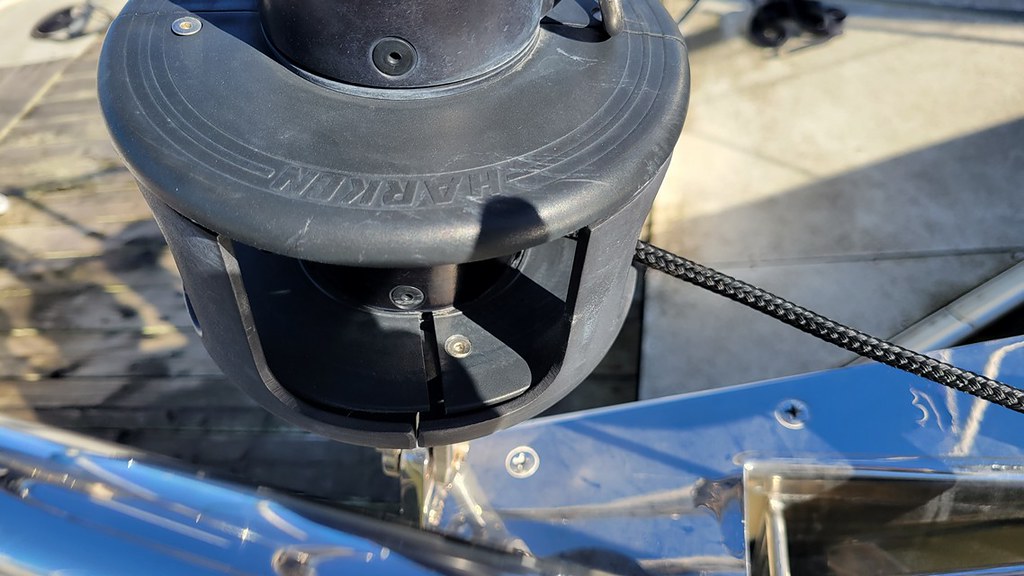
- Drum bearing and seal. Rotate the drum by hand with the furling line free. It should spin smoothly without grinding, clicking, or resistance. Any roughness in a clean drum is a bearing issue. Check the drum seal for cracking or shrinkage, which allows salt water into the bearing stack below.
- Furling line and exit box. Run the full furling line through your hands. Look for flattening, core damage, and UV degradation near the drum exit. A degraded line will fail at the moment of highest load.
- Foil joint set screws. Locate and check each set screw at the foil extrusion joints for tightness and corrosion. A loose foil section allows the joint to wobble, which lets the luff tape work into the slot and jam. This is a known cause of headsails that cannot be lowered. Foil joints should be checked on a 3-year or 30,000-mile cycle; in tropical conditions, treat the shorter interval as default.
- Swivel rotation. With the halyard disconnected, rotate the upper swivel by hand through its full range. Harken open-race Torlon swivels should feel smooth. Any roughness in a Profurl sealed bearing almost certainly indicates internal rust requiring factory assessment before departure.
- Halyard lead. Confirm the jib halyard exits the mast at an angle that feeds directly to the swivel without any potential to wrap around the forestay. A halyard that winds around the forestay wire during furling can open the lay of the wire strands - a recognised cause of forestay damage. Riggers caution that repeated halyard wraps impart rotational load on the wire and its end fittings, and that this failure mode has contributed to forestay damage in documented cases. Correct the halyard exit angle and fit a retention device if there is any risk of wrapping.
- Corrosion at set-screw seats. White or green oxide staining around any set screw seat indicates active galvanic corrosion. Do not force a corroded screw - take the system to a rigger who can extract it without destroying the extrusion thread.

Forestay Wire Inside the Foil: Gauging Condition and When to Replace
The forestay wire inside a furling foil is invisible during normal operation. You cannot see it, and because the foil rotates around it, you cannot feel it the way you can a bare shroud. A rigger must partially disassemble the foil - or run a borescope from the drum end - to inspect it properly. What to look for is broken strands that have sprung outward from the lay, called meat-hooks. They will cut anything they contact, and their presence signals fatigue that is likely already distributed through adjacent wires.
Wire specification matters for offshore forestays. Dyform 1x19 construction is preferred over standard 1x19 because its compacted strands reduce the individual wire surfaces prone to fatigue cracking under repetitive load. On larger boats requiring heavier wire diameters, most furling manufacturers now recommend switching to composite torsional cable, which resists the rotational loads imposed by the drum more effectively than any wire construction.
If you cannot confirm when the current wire was last replaced, replace it. A Cairns rigger can pull the forestay, assess the wire, and re-rig in a day. That is a very different proposition from the same job at anchor in the Torres Strait.
Service Intervals by Brand and What Cairns Riggers Can Do
Brand-specific serviceability is the factor that most affects pre-departure planning. Not every furling system can be worked on locally, and knowing the difference before you book your departure window is essential.
| Brand | Bearing Type | Field Serviceable? | Service Cycle Notes |
|---|---|---|---|
| Harken (open race) | Torlon open-race | Yes - flush with soap and fresh water; do not apply oil or grease to Torlon bearings - check current manufacturer instructions for your model before using any lubricant | Full factory rebuild at manufacturer's recommended long-service interval - consult current Harken documentation for your unit |
| Selden Furlex | Ball and roller bearings, grease-lubricated | Partial - drum seal and regrease by rigger | Annual inspection and service recommended by manufacturer; delay causes frozen bolts |
| Profurl | Carbon-steel sealed | No - factory authorized only | Any roughness or water ingress: arrange factory service before departing |
| Facnor | Varies by model | Partial - consult manufacturer documentation | Tropical conditions shorten published intervals |
The Profurl situation is the one that catches owners out most often. Carbon-steel sealed bearings corrode internally once water ingress occurs, and they cannot be cleaned, relubricated, or replaced by most local riggers. If your Profurl swivel shows roughness, stiffness, or noise, factory-authorized service is the only solution - arrange it before your departure window closes.
Harken Torlon systems are the most locally manageable. A Cairns rigger can flush and clean the system; Harken recommends flushing with soap and fresh water during regular boat washes and a thorough clean at least twice a year. Importantly, Harken specifies that oil and grease should never be applied to Torlon open-race bearings, as lubricants attract grit and impede bearing movement - check current manufacturer instructions for your specific model before applying any product. The full bearing replacement is a factory job, but the interval varies by model and usage, so confirm the current schedule with Harken or your local dealer. The problem is that boats sitting in Far North Queensland marinas between passages often miss both maintenance steps entirely. Selden Furlex drums left unserviced for many years frequently develop frozen bolts requiring professional extraction - a job that is not possible at sea.
In-Mast Furling Mainsails: Pre-Passage Inspection and Service
In-mast furling removes the mainsail from deck operations, which makes it popular for short-handed cruising - and easy to neglect because it works silently until it does not. The most important pre-passage task is removing the sail from the mast at least annually. This is not optional maintenance in tropical conditions.
With the sail out, the halyard swivel can be lowered and the lower bearing set flushed and inspected. Salt and grit entering the mast slot over a season pack the bearing set and begin seizing the swivel. By the time the swivel is noticeably stiff at the helm, significant damage has already accumulated inside. Once ashore with the sail out, check:
- Mast slot edges for deformation, burring, or sharp spots that would catch the luff tape or batten pockets during deployment
- The sail feeder and entry guide for cracks or missing plastic that could shred the luff tape at sea
- Furling line inside the mast for wear at the turning points
- Outhaul and reefing controls for kinks or chafe
- Batten-pocket integrity - a failed pocket can jam the sail inside the slot during a furl in strong conditions
An unevenly furled in-mast mainsail - cloth piling up on one side of the mandrel - indicates a feeder alignment problem or a bent mandrel. Either will worsen offshore. A sail jammed half-in, half-out of the mast in 35 knots, controllable neither as a deployed sail nor as a stowed one, is an extremely difficult situation at sea with a short crew.
In-Boom Furling Systems: Pre-Passage Checks
In-boom furling is the least common of the three systems and the least tolerant of imprecise installation geometry. The boom must sit at a specific angle relative to the mast; variation in vang tension or outhaul setting changes how the sail enters the mandrel and whether it furls evenly under load.
The critical pre-passage check is the inner tube and aft bearing. In heavy downwind conditions, the inner aluminium or carbon tube can deflect enough to jump out of the aft bearing - resulting in complete loss of sail control. This failure mode is documented by multiple offshore sailors and is not a fringe event in strong conditions.
- Confirm boom angle matches the manufacturer specification and record it before departure
- Check that the inner tube rotates without lateral play and that the aft bearing is fully seated
- Inspect sail entry and exit guides for wear, deformation, or edges that would shred the luff tape
- Test the furling drive through full deployment and full furl in calm conditions before the passage - not as you are leaving the marina
- Inspect the outhaul block and sheave for wear at the point where it bears against the boom end under load
The UV Strip and Sail Condition
A furled headsail accumulates more cumulative UV exposure than any other sail on the boat. When it sits rolled on the forestay at anchor in Cairns, the UV strip - Sunbrella or Weathermax sewn along the leech and foot - is the only barrier between direct sun and the cloth behind it. Strip failure is progressive and easy to miss on a casual inspection.
Unroll the sail entirely on a calm day and walk its full length. Look for:
- Fraying or edge separation on the UV strip, particularly at the tack and clew where load and UV exposure combine
- Chalking, fading, or stiffness in the sail cloth immediately inside the strip edge, which indicates UV penetration past the strip
- Delamination in laminate sails - adhesive failure typically appears as milky or bubbled areas when the sail is backlit
- Chafe damage along the luff tape and at points where the sail has rested against shrouds or spreader ends
Cloth specification matters for Cairns-based boats. Dacron woven polyester degrades under UV significantly more slowly than laminate adhesive systems. A well-built Dacron cruising genoa left furled through a Far North Queensland season will typically outlast a comparably built laminate sail by several years. For a Torres Strait or Indonesian passage, the case for Dacron over performance laminate is strong. The UV strip on any replacement sail should be as wide as practical, sewn with UV-resistant thread.
Replace the UV strip when it shows edge fraying, stitching separation, or colour that no longer matches the original fabric. A strip that looks worn has already stopped protecting the sail beneath it, and replacing the strip costs a fraction of what replacing the sail will.
Spare Parts and Emergency Procedures to Carry Offshore
No furling system can be rebuilt at sea. The objective of a spares kit is not to fix a failure - it is to manage one safely enough to reach the next facility. Before departing Cairns, carry at minimum:
- A full spare furling line pre-cut to length and whipped, stored dry. Furling lines chafe, fray, and occasionally part; a spare fitted in minutes changes the outcome
- Spare foil set screws and a tube of Tuf-Gel or equivalent anti-corrosion compound for any screw that works loose offshore
- A drum seal kit if your system supports field replacement (Selden Furlex); the kit is compact and the repair is within most crews' abilities in calm conditions
- A halyard wrap prevention device, or a pre-rigged secondary lead that keeps the jib halyard clear of the foil under all conditions
- A hanked-on storm jib on a separate inner forestay, rigged and ready to deploy if the furling headsail jams or becomes unmanageable in any position
The storm jib is the item most offshore crews leave behind, and the one most needed when the furler fails at sea. A headsail jammed furled leaves the boat without a working foresail; a headsail jammed half-deployed in 40 knots is a sail that cannot be managed from the cockpit at all. A hanked storm jib on an inner stay provides a balanced sail plan in either situation while the deck crew works the problem.
Write and brief a crew procedure for a jammed headsail before departure. Every crew member who stands a watch should know what a jammed furler looks like, what to release and what not to, and who handles what in the first five minutes. Running that drill alongside the dock in Cairns takes twenty minutes. At sea in the Torres Strait, those twenty minutes of preparation can determine whether the incident stays manageable.
Frequently Asked Questions
How often should a headsail roller furler be serviced in Cairns conditions?
The interval question is secondary to whether the service history can be established at all. A boat bought secondhand, or returned from extended charter, often has no documentation of when the drum was last opened or the swivel inspected. In that case, treat the system as overdue regardless of its apparent age and condition. A Cairns rigger can assess drum feel and swivel rotation in minutes and give a direct read on whether professional service is warranted before departure. Booking timing matters: riggers in Cairns are heavily occupied in the weeks before the main July-August passage window, and quality work cannot be rushed into the last few days before a departure date.
Can Cairns riggers service any furling brand, or do some need factory work?
For brands outside the four in the table - older systems, discontinued models, or less common European furlers - contact the manufacturer or Australian distributor before arriving in Cairns. The constraint is usually parts availability, not local willingness to work on the system: a rigger prepared to open an unfamiliar drum may find that the seal or bearing replacement is simply not stocked in Australia. In that situation, asking the manufacturer whether a complete replacement drum assembly can be supplied for a field swap is often a faster path than waiting for a rebuild service. Establishing this before your arrival avoids the outcome where a rigger is willing to help but cannot complete the job.
What is a halyard wrap and why does it matter for forestay safety?
A wrap that has already occurred leaves evidence on the wire after the fact. Wound strands open their lay slightly and individual wires stand proud of their neighbours - the same meat-hook pattern that indicates fatigue in any context. If your inspection reveals opened lay without a known recent cause, a past wrap is a plausible explanation and the wire has already been stressed beyond design intent. Correcting the halyard exit angle at the mast prevents the problem from recurring, but it does not restore a fatigued wire. Both repairs are needed independently of each other: fit a halyard retention device and replace the forestay if the wire shows that pattern.
Is in-mast furling reliable enough for a Torres Strait or PNG passage?
The Torres Strait adds a consideration specific to that passage: traffic separation schemes and concentrated commercial shipping in sections of confined, current-affected water. In those areas, the ability to deploy or reduce the mainsail quickly is not purely a seamanship question - it affects maneuverability in situations where a large vessel may have limited room to avoid you. An in-mast system that delays sail control, or leaves the mainsail partly deployed and uncontrollable in a squall, creates a different category of risk than the same event in open water. A well-serviced system is a genuine offshore option for this passage; one with deferred maintenance is not, regardless of how it has behaved in harbour.
Should I replace my headsail before a long offshore passage from Cairns?
If the assessment is borderline - a strip showing early wear but sound cloth underneath - consider carrying the existing sail as a spare rather than leaving it behind. A second headsail carried below decks is a genuine offshore resource: it can be hanked to an inner stay if the primary sail fails or jams deployed, and it accumulates no further UV damage when it is not sitting furled on the forestay. Brief the crew on where it is stowed and how it attaches. A new sail is the clean answer; a borderline sail carried correctly as a backup is better than no option at all in an emergency. A sailmaker can assess both in a single flat inspection and advise which path makes more sense for your specific cloth and strip condition.
What are the most important spares to carry for each major furler type?
The list matters less than when and where you source the items. Furling line and foil set screws are generally available from Cairns chandleries without special orders. Brand-specific consumables - drum seal kits, Selden grease cartridges - may need to be ordered ahead, and Cairns is not guaranteed to carry every brand's service kit in stock. Check availability well before your departure window and allow time for shipping if an item needs to come from interstate or overseas. The storm jib raises a structural question that needs answering before you are within a week of departure: if your boat does not already have an inner forestay with a fitting at the deck, adding one is a yard job and cannot be improvised on the morning you want to leave.