Leaving Cairns for a shorthanded offshore passage - whether north through the Torres Strait, northeast to Vanuatu, or northwest toward Indonesia - means handing the helm to your autopilot for most of the trip. On a two-handed boat crossing the Coral Sea, that system may steer continuously for hundreds of hours, making the constant micro-corrections a competent helmsman would make in response to each shift in sea state - but without fatigue or distraction. It is, by any reasonable measure, the most worked piece of equipment aboard. A fault mid-passage is not inconvenience: it means hand-steering in exhausting watches, or on a singlehanded or doublehanded boat, leaving the helm unattended for any essential below-deck task. Yet autopilot inspection is routinely the last item on a pre-departure list, squeezed between a deck wash and fuelling, when it should be the first.
How Cairns's Tropical Climate Degrades Autopilot Components
A Cairns-based boat ages differently from one kept in Sydney or Auckland. The combination of salt air, year-round heat, intense UV, and the region's humidity cycle puts serious load on electronics and mechanical components alike. Autopilot systems that would give many years of service in cooler, drier climates may reach the end of their useful life in a fraction of that time in tropical Far North Queensland.
The specific failure pathways:
- PCB and connector corrosion - Salt-laden air attacks circuit board traces, motor brush contacts, and connector pins continuously. Intermittent faults from corroded connectors are among the hardest problems to diagnose at sea.
- Hydraulic seal degradation - Heat and humidity cause hydraulic hose seals and O-rings to harden and develop micro-cracks. A seal that passes a dockside check may fail under the sustained workload of a passage.
- Condensation cycling inside sealed housings - When a boat moves from Cairns's warm air into cooler Coral Sea conditions at night, moisture condenses inside autopilot computer housings. This failure mode rarely appears in temperate-climate service guides; it causes internal corrosion even when the housing looks undamaged from outside.
- UV degradation - Deck-mounted components, cockpit pilots, and exposed cable runs take sustained UV damage that brittles plastics and degrades wire sheathing.
- Motor brush wear - In electric drive units, heat accelerates brush wear. A motor that appears functional may have reduced contact, dropping efficiency and raising the risk of failure under sustained offshore load.
Understanding Your Drive Unit: What to Inspect Before Departure
Hydraulic Ram Systems
Air in the hydraulic lines is the single most common cause of wandering headings in hydraulic autopilot systems. Before any offshore passage, bleed the system and inspect the fluid. Milky or discoloured fluid indicates water contamination; dark or burnt-smelling fluid means the system has been running hot. Either condition warrants a full fluid change before you leave Trinity Inlet. Carry a spare hydraulic hose and a litre of the correct fluid specification - a burst hose at sea is a steering emergency, not just an autopilot problem.
Physical checks on the ram unit:
- Actuator arm end-fittings - check for play, cracked rod ends, or corrosion at the pivot
- Mounting bolts - torque these; vibration works them loose over time
- Ram stroke - operate lock-to-lock and confirm full travel without binding
- Hose routing - hoses must not chafe, kink, or contact hot engine surfaces
- Cylinder seals - look for weeping fluid on the ram body
Linear Electric Drive Units
Inspect the pushrod end fittings and tiller pin connection carefully. These take high cyclic loads in a seaway. Run the motor and listen for roughness or a pitch change at the ends of travel - signs of worn brushes or a damaged commutator. Then check the sizing. Many boats arrive in Cairns for a passage refit with drive units specified for the boat at its unloaded weight. With offshore stores, fuel, water, and cruising gear aboard, the actual loaded displacement can push well above the unit's rated working load. The result is a motor that hunts continuously, runs hot, and fails somewhere between Cairns and Thursday Island. Confirm the drive unit's rating covers the boat as it will actually be loaded. If it does not, this is the time to fix it - not from a Coral Sea anchorage with limited spares.
The Compass and Heading Sensor: Calibration Before You Go
The autopilot steers only as accurately as its heading reference. Fluxgate compasses - common in older and many existing autopilot installations, though solid-state nine-axis sensors are now standard in newer units - are sensitive to magnetic interference and require recalibration whenever the boat's magnetic environment changes significantly.
Cairns skippers frequently miss calibration loss after:
- Installing a new lithium battery bank - the cells and their management systems introduce magnetic fields not present with the previous lead-acid setup
- Adding an inverter or high-draw appliance near the compass
- Fitting new anchors, chain, or stainless fittings near the bow - chain lockers close to fluxgate units are a common interference source
- Software updates that reset stored calibration data
The calibration procedure requires motoring in slow, full circles in calm water, with the engine running - running the engine during calibration ensures its magnetic field is captured in the result. Most manufacturers specify a boat speed below 3 knots for the circles; check your autopilot manual for the exact procedure. Trinity Inlet has suitable flat-water areas for this. After calibration, verify the result against a hand-bearing compass on several headings. A deviation of more than a degree or two on any heading warrants a second run. If your system runs older autopilot hardware, check whether a firmware update is available - calibration drift on some units can cause progressive course deviation that compounds over a long passage.
The compass calibration check is the most overlooked pre-departure step in autopilot preparation - and the one most likely to produce an unexpected position error three days offshore.

Rudder Feedback Transducer: The Component Most Often Skipped
The rudder feedback transducer tells the autopilot computer exactly where the rudder sits at any moment. Without it, the computer only knows the boat's heading - not whether the rudder is at midships, hard over, or somewhere past it. In flat water this matters less. In a quartering trade-wind sea, with waves pushing the stern sideways repeatedly, it matters enormously.
Without rudder feedback, the computer applies helm correction, waits to see the heading change, then applies more. By the time the heading corrects, the rudder may be well past neutral. The boat hunts - weaving continuously from side to side - and in heavy conditions can be pushed into an uncontrolled gybe or broach.
To test the transducer: with the system in standby, move the wheel slowly lock-to-lock and watch the rudder angle indicator on the pilot display. It should track smoothly and return to zero at midships. Jerky movement, a display that reads zero regardless of helm position, or a persistent offset at midships all indicate transducer problems. The fix is usually straightforward - a new transducer, correct installation angle, and recalibration - but it is not something to discover offshore.
Power Supply and NMEA 2000 Network
The drive unit should run on a dedicated fused circuit from the battery bank, not shared with instruments or lighting. Inspect the wiring for correct gauge to the run length, and check both terminal ends for green corrosion at ring terminals.
Power draw varies widely with conditions. In calm, balanced sailing the draw is modest. In a seaway with continuous rudder correction it can run at several amps continuously for hours. Across a thousand-mile passage, the autopilot accounts for a significant share of daily electrical demand. Work out the expected daily ampere-hour consumption and check it against your solar or wind generation and battery bank capacity. An adaptive course computer - which corrects continuously for current set and wind shift using smaller, more efficient corrections - uses meaningfully less power than a simple proportional pilot and improves VMG on long passages.
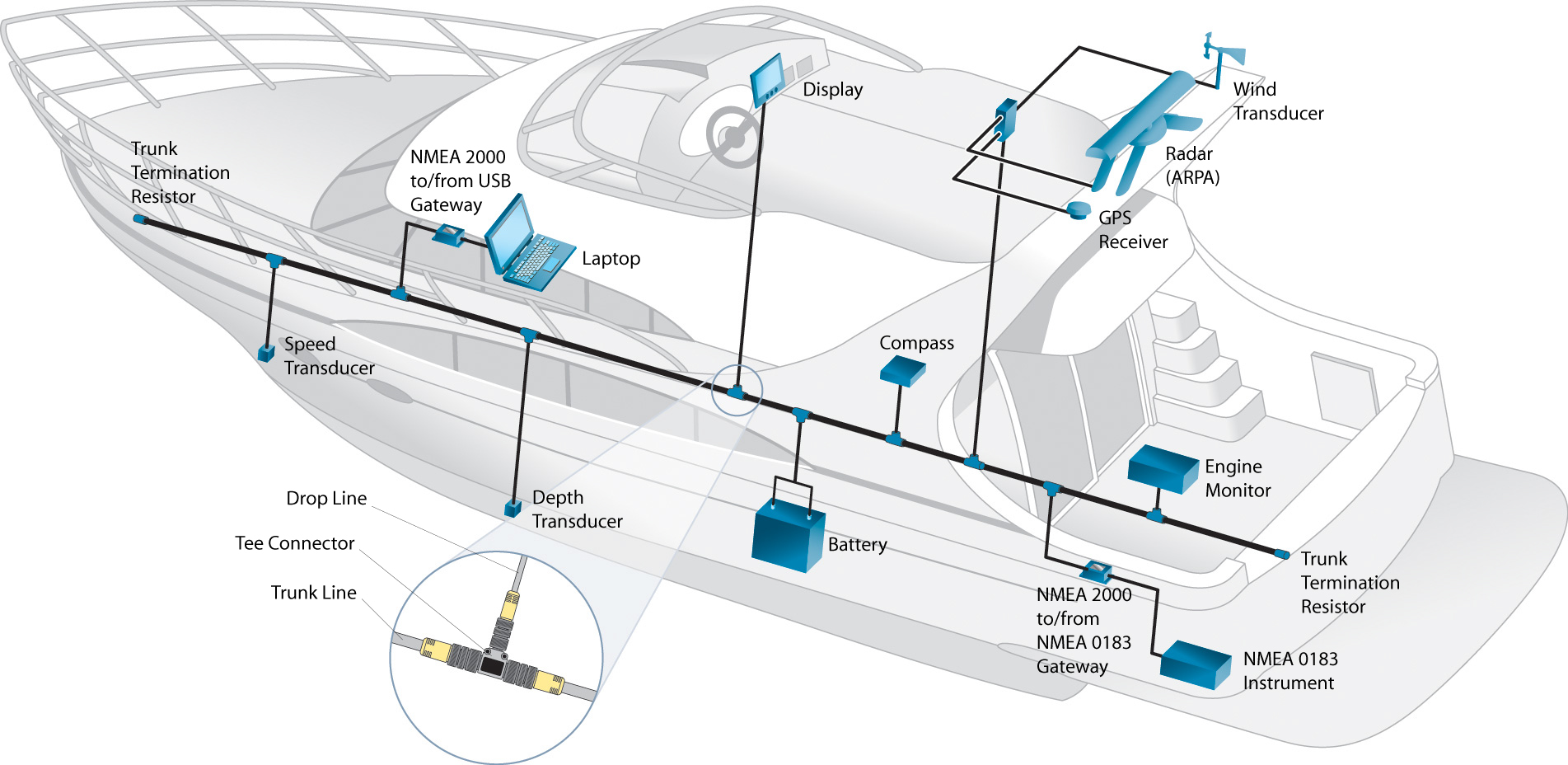
On the NMEA 2000 network: inspect every backbone connector for corrosion. Connectors exposed to spray or bilge condensation require an IP67 waterproof rating as a minimum. Unrated connectors corrode internally and produce intermittent heading dropouts that are very difficult to diagnose at sea. Confirm the backbone has exactly two terminating resistors - one at each physical end. A missing terminator causes signal reflection errors that can drop network devices intermittently under load.
Sea Trial and Calibration in Trinity Inlet
No pre-departure inspection is complete without a structured sea trial. This is the minimum acceptable protocol before sailing north:
- Motor to a clear area of Trinity Inlet or the outer harbour and complete compass calibration circles at slow speed with the engine running, so the system captures the actual magnetic environment the autopilot will operate in offshore. Follow your system manual for the recommended speed, typically below 3 knots.
- Engage the autopilot on a known heading and compare the steered course against the hand-bearing compass on at least three headings separated by 90 degrees or more.
- Test auto-hold in flat water at low speed. The boat should hold course with minimal correction, not oscillate.
- Move to an area with boat wash or residual chop and observe the pilot's response to cross-swell. If the boat hunts, check gain settings, rudder feedback, and linkage before attributing it to sea state.
- If a wind vane is fitted, engage it and confirm line runs, bearings, and the vane-to-tiller connection all function correctly.
- Deploy and test the emergency tiller. Confirm it fits, steers, and clears all cockpit obstructions. Many skippers discover on a night passage that the emergency tiller fouls a lazarette hatch or requires two people to ship.
Backup Steering: Wind Vane, Second Autopilot, or Both
An autopilot that fails offshore leaves the crew hand-steering. For a shorthanded boat on a multi-day passage, hand-steering in shifts is manageable for a day and unsustainable over a week. Backup steering is not optional for a serious offshore departure.
A wind vane self-steering system uses no electrical power and operates entirely independently of the ship's DC system. This makes it the most reliable backup available - it cannot be stopped by a battery failure, an electrical fault, or a blown fuse. Cairns riggers can inspect vane gear mounting, bearings, and line runs as part of a pre-departure check. The limitation is that wind vanes steer to apparent wind, not a GPS waypoint, so any wind shift produces a course shift.
A second dedicated below-deck autopilot drive unit connected to the same steering quadrant gives full waypoint-tracking redundancy within the electrical system. A cockpit tiller pilot used as emergency backup is a weaker solution - these units are not engineered for continuous offshore loads, and any boat heavy enough to require a primary below-deck pilot will quickly overwhelm a tiller pilot in a seaway.
When to Service vs Upgrade
| Situation | Service needed | Upgrade needed? | Risk if deferred |
|---|---|---|---|
| Correctly sized unit, under 2 years tropical service | Fluid check, calibration, connector inspection | No | Low if inspection passes |
| Correctly sized unit, over 3 years tropical service | Full service - brushes, seals, bleeding | Assess motor condition first | Moderate - degraded components likely |
| Unit undersized for loaded offshore displacement | Service existing unit as stopgap only | Yes - before departure | High - unit will be overloaded continuously |
| Intermittent faults, hunting, heading dropout | Full diagnostic before offshore use | Depends on root cause | High - intermittent faults become total failures offshore |
| No rudder feedback transducer installed | Install transducer as part of pre-passage refit | Component upgrade required | High in quartering seas - hunting, risk of broach |
The relevant comparison for most Cairns skippers is not service versus upgrade in financial terms. It is: fix it here, in a port with qualified marine electricians, hydraulic engineers, and authorised service agents for major brands - or manage a failure somewhere between the Coral Sea and the Arafura Sea, where parts are difficult to source and a haulout may be weeks away.
Frequently Asked Questions
How do I know if my autopilot drive unit is undersized for an offshore passage?
Compare the drive unit's rated working displacement against your boat's weight with full offshore stores - water, fuel, food, and all passage gear loaded. If the loaded weight is not documented, a marine engineer can estimate it from waterline measurements or a load cell at haulout. Drive unit sizing information appears in the manufacturer's current documentation; a marine electrician familiar with your system can check the rating against your actual load before you depart.
How often should I bleed a hydraulic autopilot in tropical conditions?
In tropical Far North Queensland, check fluid condition annually as a minimum and before every offshore passage regardless of the last service date. Milky fluid indicates water contamination; dark or burnt fluid means the system has run hot. Both warrant a full fluid replacement. Heat and humidity cause seals to harden faster in this climate than service intervals designed for temperate regions would suggest.
Will a compass calibration done in Cairns remain accurate for the whole passage?
Calibration remains accurate until the boat's magnetic environment changes - by adding or removing electrical equipment, relocating heavy metal items, or taking on ferrous cargo. A calibration done near steel marina pontoons or other boats may not be accurate in open water. Perform calibration in clear water away from the marina, verify against a hand-bearing compass on multiple headings, and repeat it after any significant electrical work done before departure.
What is the most common reason an autopilot fails on passage but not at the dock?
Sustained load under real conditions. Faults that are marginal in harbour - a motor with worn brushes, a hydraulic seal that only weeps under pressure, a connector with mild internal corrosion - become outright failures when the system runs continuously for days in a seaway. The pre-departure sea trial should run the system at load for an extended period, not just verify it engages and holds course in flat water.