Cairns sits at the natural gathering point for offshore-bound yachts before the June-July trade wind window opens toward Papua New Guinea, the Solomon Islands, and the Arafura Sea. Boats arrive from the east coast and from New Zealand months beforehand carrying lists of metalwork jobs that have been deferred too long - solar arches that need to handle real offshore loads, davits that must lift a loaded dinghy in a seaway, bow rollers never properly specced for the chain in use, and windvane mounting brackets that have to fit an individual transom nobody has manufactured for before. The challenge is not finding a fabricator in Cairns - several operate at a high standard. The challenge is arriving with a proper specification so the job is quoted accurately, built correctly, and finished before the departure window closes.
Why Passage Preparation Concentrates Custom Metalwork in Cairns
Cairns is the last major provisioning and refit port before the extended offshore passages that characterise the northern cruising season. Boats that have sailed comfortably from Sydney or Brisbane, making do with original factory hardware, discover that factory hardware was built for coastal conditions. A solar arch that holds two panels in a marina does not necessarily survive repeated knockdowns on a ten-day crossing. Davits suited to launching a tender in calm water are a different structure from davits that must carry a loaded inflatable through three-metre swells.
The jobs that consistently appear in Cairns before departure fall into a recognisable pattern:
- Solar arches - new builds or reinforcement of existing lightweight structures to carry panels, radar domes, antenna bars, and VHF aerials without fatigue cracking at tube junctions
- Dinghy davit systems - typically replacing folding or single-arm designs with offshore-rated twin-arm systems capable of carrying a loaded rigid inflatable in a seaway
- Bow roller and stemhead upgrades - fabricated to match the vessel's forestay geometry and sized for the actual chain in use
- Pushpit and pulpit repairs or replacements - often prompted by corrosion at base plate welds found during the annual haul-out
- Swim platform extensions and offshore boarding ladders
- Custom windvane transom mounting brackets, where no two vessel transoms are the same geometry
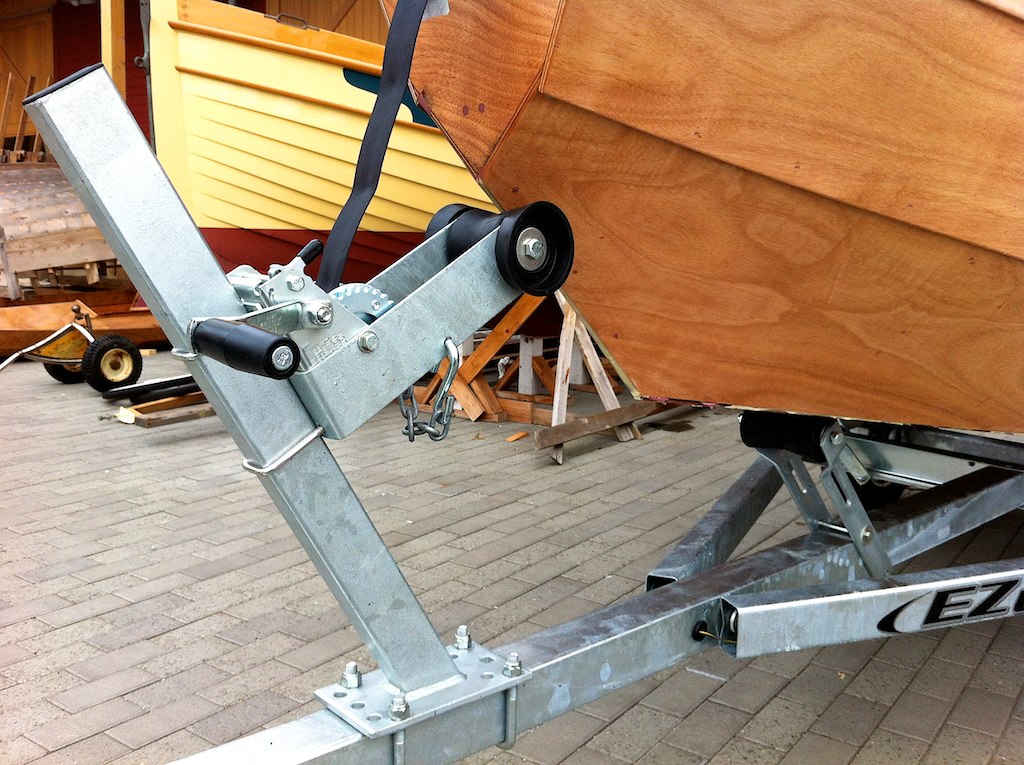
Material Selection in Tropical Queensland: What the Temperature Changes
The standard answer - "use 316 stainless" - is correct but incomplete. Grade 316L stainless steel is the low-carbon variant of the 316 family, formulated with elevated molybdenum content and a deliberately restricted carbon level compared with standard 316. The L designation means low carbon, which matters specifically for welded structures: when stainless is welded, carbon at grain boundaries can combine with chromium to form chromium carbides, depleting the corrosion-resistant chromium layer immediately around the weld - a process called sensitisation. The low carbon of 316L suppresses this. For any welded offshore structure, 316L is the minimum acceptable grade. Standard 316 is not an acceptable substitute for welded work in a marine environment.
The complication for Queensland is water temperature. Above 25 degrees Celsius, 316L becomes measurably more susceptible to crevice corrosion and pitting in oxygen-restricted joints - exactly the geometry found at tube-to-tube junctions, at base plate welds, and under rubber-lined tube clamps. Published marine corrosion research documents higher crevice corrosion rates on 316L at crevice joints in tropical seawater than in temperate climates - consult marine corrosion engineering references for data applicable to the specific exposure. For standard tube walls used in offshore fabrication, that rate is tolerable with regular inspection, but becomes critical when crevices are hidden under paint, under clamps, or inside incompletely fused socket welds.
5083-H116 aluminium is the structural alternative for arches, davit arms, and long-span booms where weight matters. Governed by the relevant ASTM marine aluminium alloy specification - which requires passing visual exfoliation and mass-loss qualification tests - its seawater corrosion rate is significantly lower than 316L at equivalent crevice-exposed joints. Its base-metal tensile strength is high for a lightweight structural alloy, but here is the limitation that must be designed around: when welded with the correct filler alloy - 5356 or 5183 - the weld achieves significantly below base-metal strength, roughly half depending on joint geometry and configuration. A structural calculation that ignores that reduction is not a structural calculation.
Duplex grades such as 2205, and super duplex grades with a high Pitting Resistance Equivalent Number, offer roughly three times the pitting resistance of 316. The practical answer for a cruising yacht is: duplex for small, highly stressed components in permanent seawater contact - stemhead bow roller pins, forestay attachment points, windvane steering shaft components. Hydrovane uses super duplex for its inner steering shaft precisely for this reason. For large structural weldments such as arches and davit arms, the cost premium and fabrication complexity of duplex are harder to justify if 316L is detailed correctly with crevice geometry eliminated at design stage.
| Property | 316L Stainless | 5083-H116 Aluminium | Duplex 2205 |
|---|---|---|---|
| Crevice corrosion in tropical seawater | Moderate - elevated at crevice joints in warm tropical conditions | High resistance - well below equivalent stainless figures in similar exposure | High - PREN well above 316L |
| Weld strength retention | High with correct 316L filler | Significantly below base-metal strength - weld geometry must account for the reduction | High with correct duplex filler |
| Weight at equivalent section | Heavier baseline | Roughly one-third the weight of steel | Heavier than 316L |
| Best-suited yacht applications | Arches, davits, bow rollers, pushpit | Arch spans, davit arms, swim platforms | Roller pins, high-load point fittings |
Galvanic Isolation: The Dissimilar-Metal Problem That Silently Destroys Aluminium
Connecting aluminium structure to stainless steel hardware in seawater creates a galvanic cell. Grade 316 stainless and grade 5083 aluminium sit far apart on the electrochemical galvanic series in seawater - far enough that the potential difference between them substantially exceeds the threshold at which accelerated galvanic corrosion begins. The aluminium, as the less noble metal, corrodes preferentially wherever the two metals meet through a conductive electrolyte.
Isolation at every contact point means three things in practice:
- Duralac jointing compound applied to all mating surfaces before assembly - the standard for aluminium-to-stainless joints in a tropical environment and not optional
- Nylon or PTFE washers under every bolt head and nut where a stainless fastener passes through aluminium tube walls or plate
- Anodised aluminium where the base specification allows it, adding an aluminium oxide insulating layer at mating surfaces
- Stainless arch feet sitting on aluminium deck plates require an isolating gasket between them, not just jointing compound on the fasteners
A fabricator who does not raise galvanic isolation when designing a mixed-metal structure is not designing for the marine environment. Ask explicitly what isolation is specified at every stainless-to-aluminium contact in the design before work begins.
Specifying a Solar Arch: Panel Area Before Tube Diameter
The most common specification mistake is to start with tube diameter and work backwards. The correct sequence is to start with panel area, derive arch geometry, then determine structural tube requirements based on the loads that geometry must carry.
A 600 W system using four 150 W panels - each approximately 1680 mm by 1000 mm - requires an arch surface at least 2.1 m wide and 1.1 m deep to fit two panels side by side in landscape orientation with structural clearance. That governs minimum arch geometry before any other features are added. Add a radar dome bracket, an antenna bar, an instrument mount, and a wind generator, and the arch beam span increases further and the tube junction loadings rise accordingly.
The standard offshore arch tube specification is 48.3 mm OD with a 3 mm wall in 316L stainless - equivalent to the 1.9-inch OD by 0.120-inch wall specification used by established offshore hardware manufacturers on integrated davit-arch systems. Tubes of 25 mm OD are sufficient for a panel-only shade structure in a marina but are not adequate for integrated davit arms, offshore shock loading, or the cyclic fatigue from a radar dome's mass moving in a seaway. If davit arms are incorporated into the arch, the main arch tubes must be sized for the combined bending moment at the junction with the davit arm. That calculation should be explicit in any quote.
Davit Systems: Working Load, Dynamic Multiplier and What Gets Skimped
A realistic offshore davit working load is easy to calculate and rarely done accurately. A 3.2 m inflatable tender weighs approximately 60 kg. A 15 hp four-stroke outboard weighs approximately 43 kg. Fuel, dock lines, spare parts, and gear add approximately 15 kg. The static hanging load is roughly 118 kg. Industry practice for offshore davit design is to engineer to 2.5 to 3 times static working load to handle seaway shock - the dynamic loading that occurs when a following sea lifts the stern and the dinghy drops hard on the blocks. That means the design load for a system carrying 118 kg static is at minimum 295 kg, and a properly rated offshore system is designed to 354 kg.
The practical consequences of this calculation are specific:
- Davit arms fabricated from 25 mm tube do not meet this design load - the section modulus is insufficient for the bending moment at the arm root
- The attachment point where the davit arm meets the arch or the stern rail is the highest-stress location; weld geometry and reinforcement gussets there are structural, not cosmetic
- Davit blocks and cleats must be rated to the actual design load, not a nominal coastal dinghy weight
- Wire bridles connecting davit arms to the dinghy must be sized for the design load, not the static weight
- Positive-locking davit heads are required offshore; friction-only designs allow the dinghy to swing when the vessel heels
When asking any fabricator to quote davit work, ask what load the system is designed to and at what multiple of static working load. If they cannot answer that question directly, the system has not been properly engineered.
Bow Roller and Anchor Handling Hardware
Factory bow rollers on production cruising yachts are frequently underbuilt for the actual chain size in use and the load imposed by a heavy offshore anchor. A custom fabricated stemhead fitting addresses geometry - matching the forestay attachment exactly, accommodating the specific windlass opening angle - and structural rating simultaneously.
For a 40 to 50 ft offshore yacht, the bow roller must accommodate at minimum 10 mm chain. The stemhead fitting must be through-bolted using M12 316 stainless fasteners as a minimum - not self-tappers, not machine screws into a backing block. The deck must be backed with a 3 mm 316 stainless plate covering at minimum a 150 mm by 150 mm contact area. The backing plate distributes anchor shock load across the deck laminate rather than concentrating it at the fastener holes. A custom fabricator can build the backing plate to match the deck contour exactly, which a standard off-the-shelf fitting cannot achieve without shimming and compound curves.
The roller pin - the stainless pin around which the chain runs - is a candidate for duplex or super duplex stainless given the continuous seawater contact and high cyclic bearing load in a headsea. It is a small component with a significant consequence if it fails offshore.
Pushpits, Pulpits, Stanchion Bases, Swim Platforms and Windvane Brackets
Pushpits and pulpits on 40 to 50 ft cruising yachts are typically fabricated from 25.4 mm or 31.75 mm OD 316L tube. For offshore bow pulpits exposed to green-water impact, minimum wall thickness is 2.0 mm. A 1.6 mm wall tube adequate in a marina anchorage can deform at a base plate weld when a solid wave loads the bow rail.
Stanchion bases corrode from the inside out at the deck flange on older vessels where the base seal has failed. Replacement bases should be fabricated with a closed top cap or sealed with closed-cell foam fill to prevent water ingress, and the deck backing plate should be inspected and replaced if corroded. A base plate that looks intact from above can be paper-thin at the flange.
Swim platforms fabricated in 5083 aluminium plate offer significant weight saving over stainless at the stern, beneficial for trim and stability. They require anodising and isolation hardware at every fastener penetration through the transom - the galvanic isolation requirement applies here as directly as anywhere on the vessel.
Windvane transom mounting brackets are the highest-specification custom item on this list. The Hydrovane unit itself is built in marine-grade 316 stainless with a super duplex inner shaft - the item a Cairns workshop actually fabricates is the bracket tailored to the individual vessel's transom geometry. The bracket carries the torque load of the vane servo system, must fit the specific transom with no flex, and works continuously for the entire passage. This is not a job to cut cost on. Getting it wrong means retrieving the vane from the ocean.
Working With Cairns Fabricators Before an Offshore Departure
The practical constraint is time. During the pre-passage season rush from April through June, custom arch and davit fabrication lead times in Cairns commonly extend to four to six weeks for a new build. Work ordered in March or the first two weeks of April has the strongest chance of completion before the June-July departure window. Work ordered in May risks missing it - not because fabricators are slow, but because the demand concentration is real and capacity is finite.
Get the metalwork specification sorted before the vessel hauls out. A fabricator can measure, quote, and order material while the boat is still in the water, leaving haul-out time free for hull and running gear work that actually requires the boat to be on the hard.
The sequence that produces the best outcome when approaching a Cairns fabricator:
- Bring a clear sketch or drawing with key dimensions - arch width, davit arm length, panel size, stern geometry - even if the fabricator will come to the boat to verify
- State working loads explicitly: panel count and weight, dinghy weight, outboard size and weight, fuel and gear load
- Specify the material grade required - 316L for stainless weldments, 5083-H116 for aluminium - and ask the fabricator to confirm that is what the material certifications will show
- Ask what welding qualification standard their welder holds for safety-critical structural welds - the relevant Australian welding procedure qualification standard covers steel and the applicable ISO or AWS aluminium welding qualification code covers aluminium; ask which applies to the specific alloy and joint type in the job
- Confirm the galvanic isolation approach for every aluminium-to-stainless contact point in the design
- Get the lead time confirmed in writing and understand at what stage of the haul-out installation should happen, so scaffold access and hull work do not conflict
Several workshops serve the offshore passage-prep market in the Cairns area. BME NQ holds marine welding accreditation across aluminium, stainless, CuNiFer (copper-nickel-iron alloy), and mild steel, and counts Australian Border Force vessels among its commercial clients - a reasonable proxy for the quality standard expected in safety-critical marine fabrication. Orange Fabrication offers emergency marine repairs and custom stainless, mild steel, and aluminium welding specifically for Far North Queensland yachts and commercial vessels. Rathbone Marine Engineering specialises in stainless steel and aluminium fabrication for marine engineering applications, describing its work as delivering high-strength, corrosion-resistant components built for the marine environment. For current availability and lead times, contact each workshop directly; Cairns marine trades businesses are listed through the Cairns Port Authority and local marine industry directories.
Frequently Asked Questions
Can standard 316 stainless be used instead of 316L for a welded solar arch?
Not for welded offshore work. The more important practical question is how to verify you are actually getting 316L once work is underway. Ask for the material test certificate - the mill cert - before material is cut. The grade designation is printed on the cert; it cannot be confirmed from the finished fabrication by eye, since standard 316 and 316L are visually identical. A workshop that cannot produce mill certifications for the stainless in stock is not operating at the standard expected for safety-critical marine work.
How long will a 316L arch realistically last in tropical conditions?
The practical answer depends less on material theory and more on inspection practice. What shortens arch life in tropical conditions is concentrated attack at the locations where the mechanism gathers: base plate welds that pool water, socket joints that never fully dry out, and areas under rubber saddles that trap salt crystals between seasons. Annual probe or tap testing at these points, with weld repair or recoating when early surface attack is found, extends service life far more reliably than trusting any theoretical figure. The arch that fails early is typically the one that was never inspected after installation.
Is an aluminium arch structurally adequate for offshore use given the lower weld strength?
Yes, when designed correctly. The less-discussed consideration is repairability: aluminium can be welded at most Pacific island ports that handle commercial fishing vessels, but weld quality and correct filler alloy availability vary. Stainless is more universally repairable with the wire MIG equipment common throughout the region. If the passage plan includes extended time in remote anchorages away from established repair facilities, the repairability comparison is worth raising with the fabricator when choosing material for high-load junctions.
What welding certification should I ask about for a safety-critical fitting like a windvane bracket?
Ask whether the shop holds a welding procedure specification - a written record of parameters including wire type, travel speed, and heat input - for the specific alloy and joint type being used. A shop relying on the welder's experience alone rather than a documented procedure is harder to audit. As a visual check after the job: a sound weld bead is consistent in width, free of pinholes, and shows no colour variation in the heat-affected zone indicating excessive heat input. A wandering bead or visible porosity is grounds to ask for the work to be redone before installation.
Why does ordering in May risk missing the June departure window?
If the schedule is already tight, the useful question is what to prioritise and what can wait. Safety-critical structural items - a windvane bracket, a bow stemhead fitting, structural davit arms - are not deferrable because the consequence of failure offshore is severe. Solar arches and davit systems for a dinghy that could alternatively travel on deck are higher priority than cosmetic work but lower than structural fittings. Stanchion bases on vessels with structurally sound existing stanchions can often wait for a suitable port further along the route. Identifying what is genuinely safety-critical and ordering those pieces first reduces risk even when the full job list cannot be completed before departure.
Do stainless bolts through an aluminium arch tube really need galvanic isolation hardware?
Yes, without exception, and the follow-on question is how to inspect after installation. Galvanic attack at a fastener hole proceeds invisibly until it is advanced, so external visual inspection is not sufficient. Remove one or two fasteners per year from the locations most exposed to pooled seawater - typically the arch feet - and examine the aluminium tube wall at the fastener hole. Early galvanic attack shows as white powdery aluminium oxide around the hole edge on the internal wall surface. At that stage it is a manageable repair: clean, treat with an inhibiting compound, install new isolating washers. Finding it during a haul-out is a minor job; finding it when a fitting pulls free underway is not.