Leaving Cairns on an offshore passage - north through Torres Strait, east to the Coral Sea islands, or farther - puts a crew beyond helicopter range, beyond mobile coverage, and beyond any realistic prospect of fast professional help if something goes wrong. The gear on board matters, but gear without trained hands is just ballast. This guide explains the specific certificates the skipper and crew should hold before departure, what each course actually demands, where to get trained in and around Cairns, and how to sequence certificates so nothing expires before you clear the heads.
The Australian Sailing Safety and Sea Survival Course
The Australian Sailing Safety and Sea Survival Course - the SSSC - is the baseline offshore training certificate in Australia for recreational sailors. It is the qualification that World Sailing Offshore Special Regulations recognise, that Australian Sailing mandates for offshore racing categories, and that most bluewater cruising handbooks treat as a non-negotiable before a crew goes offshore.
The course has a minimum contact-hour requirement set by Australian Sailing - check sailing.org.au for the current figures, as these are updated with each regulatory revision. It is delivered in one of two formats: a combination of in-person evening sessions with a full practical day, or an online e-learning module followed by a single practical day. The practical day cannot be skipped or shortened regardless of format. The course cannot be completed entirely online.
Accredited providers are listed through the course-finder at sailing.org.au. The certificate issued at completion is recognised by World Sailing for offshore racing and by Australian Sailing for affiliated racing categories. It is not a commercial maritime qualification and does not carry AMSA or IMO recognition - that distinction matters and is covered later.
One operational fact that shapes planning for Cairns sailors: accredited providers who run the SSSC with a wet-drill practical component are concentrated in the southeastern states. No Queensland-based provider is consistently running the course in Cairns at time of writing. Most Far North Queensland sailors travel to Brisbane for the practical day, and some travel to Sydney or Melbourne. That is not an afternoon errand - it requires at least a weekend trip, often booked weeks or months in advance.
Inside the SSSC: Theory, the Exam, and the Wet Drill
The SSSC theory component is structured around five subject areas. Each is examinable. The exam requires a high pass mark - confirm the current threshold at sailing.org.au, as it is set by Australian Sailing and candidates who do not reach it must resit before proceeding to the practical component or receiving a certificate.
The five areas are:
- Boat Preparation - safety equipment, inspection routines, pre-departure documentation
- Crew Preparation - watchkeeping, fatigue management, briefing crew before offshore departure
- Weather - reading forecasts, understanding fronts and squalls, go/no-go decision making
- Emergencies - fire, flooding, man overboard, DSC radio, EPIRB activation
- Abandon Ship - decision sequence, communication, life raft deployment, in-water survival
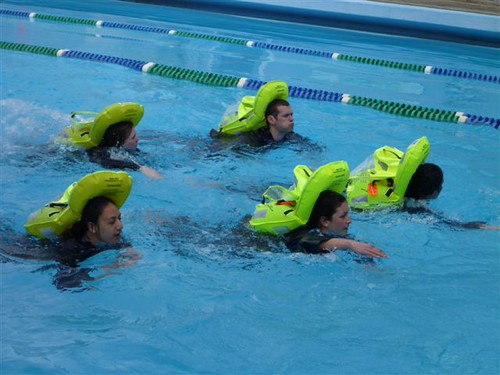
The practical wet drill is where the SSSC separates itself from every paper-based course available. Candidates are not observers. Each person must personally board and self-right a deployed life raft in water. Each person must complete an in-water capsize drill. Each person must ignite a live handheld flare.
The live flare shoot is particularly useful for anyone who has never held a burning flare. The heat, the smoke direction relative to wind, and the grip required are not intuitive. Doing it once in a controlled training environment removes hesitation when it matters.
Certificate Validity, the Refresher Window, and the Full-Course Trap
An SSSC certificate is valid for a fixed period after the date of issue - check sailing.org.au for the current validity window, as this is set by Australian Sailing. When that period approaches expiry, a refresher course can renew the certificate, but only if the refresher is completed within a defined window on either side of the expiry date. Miss that window and the refresher option disappears entirely. The full course must be repeated from scratch.
This catches sailors who plan loosely. A skipper whose certificate lapsed a couple of years ago might assume a refresher afternoon will get them current. It will not if they have passed the renewal window. They are back to the beginning: theory, exam, practical day, wet drill, live flare. Check the current validity period and refresher window at sailing.org.au, calculate your own expiry, and plan accordingly.
The same calculation applies to crew collectively. Certificate management for an offshore passage is a shared responsibility, not an individual one. If several crew members are approaching expiry, the question of whether the boat meets minimum crew training fractions needs to be answered against their actual certificate status - not what they intend to do before departure.
What World Sailing Offshore Special Regulations Require
World Sailing publishes Offshore Special Regulations that set minimum safety standards across offshore passage categories. Category 0 is the most demanding. Category 1 covers fully offshore passages well beyond coastal waters. Category 2 covers races conducted within a defined distance of a safe harbour. The SSSC satisfies the training component of these regulations for Category 0, Category 1, and selected Category 2 offshore races under Australian Sailing affiliation.
"Offshore Special Regulations are designed to give all reasonable protection to offshore racing crews - they do not and cannot guarantee safety in all circumstances."
World Sailing Offshore Special Regulations
For Category 1 races under the World Sailing framework, the regulations require a minimum fraction of the crew - including the person in charge - to have completed safety training within a set period, and separately require a minimum number of crew holding a recognised first aid qualification. For current fractions and minimum numbers, see the latest edition of the World Sailing OSR at sailing.org.au, as these requirements are updated with each regulatory cycle.
Category 0 requirements go further. Every crew member must hold a World Sailing Offshore Personal Survival Techniques Certificate - this is not the same as the SSSC and requires separate certification. The regulations also require at least one crew member to hold STCW Proficiency in Medical First Aid and at least one other to hold STCW Elementary First Aid. For a recreational cruiser not entering a formally sanctioned Category 0 race, these requirements function as a benchmark for the training profile a fully prepared offshore crew would carry.
For non-racing offshore passages, the regulations are a useful checklist rather than a legal obligation. A crew heading from Cairns to Thursday Island or beyond will face conditions that make Category 1 standards sensible regardless of whether anyone is timing them.
Marine First Aid for Offshore: Why the Remote Area Unit Differs
Standard first aid training in Australia - the HLTAID011 unit - is built on a core assumption: professional emergency services will arrive within minutes. The assessment criteria, the treatment protocols, and the scenario design all reflect that assumption. On an offshore passage from Cairns, that assumption is wrong by hours or days.
HLTAID013 - Provide First Aid in Remote or Isolated Site - is the Australian unit designed specifically for prolonged casualty management. It covers arterial tourniquet application, pain management over extended periods, monitoring a deteriorating casualty through a long watch, and patient evacuation planning: preparing someone for a helicopter winch, a vessel-to-vessel transfer, or a prolonged passage to port in serious condition. These are the skills that matter when a crew member has a suspected appendicitis, a severe laceration, or a jellyfish envenomation and the nearest emergency department is two days away.
- HLTAID011 (Standard First Aid) - covers assessment, CPR, AED, bandaging; assumes professional help arrives promptly; check training.gov.au for current certificate validity period
- HLTAID009 (CPR only) - narrower scope, shorter validity period than full first aid; renewal required more frequently - confirm the current interval at training.gov.au
- HLTAID013 (Remote or Isolated Site First Aid) - covers prolonged casualty management, arterial tourniquets, pain management, evacuation planning; appropriate for offshore passages where rescue may be many hours away
Standard first aid skills transfer offshore and HLTAID011 is better than no certificate at all. But if one course can be chosen for a Coral Sea passage, the remote area unit is the one that covers what actually happens when no ambulance is coming.
Marine-specific first aid courses from providers including Pacific Sailing School and Marine Safety Works extend this further still. Courses covering marine stings - including irukandji and box jellyfish relevant to Far North Queensland waters - decompression illness in crew who also dive, and offshore patient assessment add content that neither HLTAID013 nor the SSSC covers in depth. These are complementary to the nationally accredited units, not substitutes for them.
Getting Trained in Cairns: What GBRIMC Offers
The Great Barrier Reef International Marine College - GBRIMC - operates as a campus of TAFE Queensland in Cairns. Its primary purpose is professional seafarer training, and its facilities reflect that. The college has an on-site immersion pool purpose-built for sea survival wet drills - a substantial body of water used for life raft deployment and capsize exercises as part of STCW training. For sailors based in Cairns, it is the most practical facility for water-based safety training without travelling south.
GBRIMC short courses issue certificates directly through AMSA and comply with IMO STCW requirements. Those certificates carry international recognition across all countries on the IMO White List - a meaningful distinction for passages that move beyond Australian waters. A Torres Strait transit continues into international waters, and crew heading for Papua New Guinea, the Pacific, or Southeast Asia will find AMSA-issued STCW certificates accepted in those jurisdictions in ways that the Australian Sailing SSSC is not.
The college is currently undergoing a major expansion adding new simulation and emergency response training spaces. That work reflects Cairns's standing as a genuine maritime training hub for the northern region. Check GBRIMC directly for current course availability and scheduling, as construction may affect timetabling.
One important distinction: GBRIMC does not deliver the Australian Sailing SSSC. Its sea survival courses follow the STCW framework, not the Australian Sailing framework. For sailors who need an SSSC specifically - for affiliated racing or for World Sailing OSR recognition - GBRIMC does not currently satisfy that requirement. The two course types overlap substantially in content but are issued by different authorities and recognised in different contexts. Cairns-based sailors still need to travel for the SSSC practical day.
STCW Options: When the Commercial Qualification Makes Sense
STCW Basic Safety Training is the entry-level commercial maritime qualification, required for anyone crewing a vessel above a specified size for pay. It was designed for professional seafarers. Some recreational offshore crews complete it anyway because of the training depth, the fire module in particular, and because the international recognition it carries is broader than the SSSC.
The five modules are:
- Personal Survival Techniques - life raft operations, in-water survival, helicopter evacuation procedures
- Fire Prevention and Firefighting - fire behaviour, suppression techniques, use of breathing apparatus
- Elementary First Aid - casualty assessment, resuscitation, wound and shock management
- Personal Safety and Social Responsibilities - shipboard safety culture, watchkeeping obligations
- Security Awareness - vessel security protocols and threat recognition
The table below sets the main recreational and commercial certificates side by side across four practical dimensions. No specific validity periods are shown - check with the issuing body for current figures as these are updated periodically.
| Certificate | Primary use | Recognition scope | Practical component |
|---|---|---|---|
| Australian Sailing SSSC | Recreational offshore sailing and affiliated racing | Australian Sailing races; World Sailing Categories 0-2 | Mandatory wet drill and live flare |
| STCW Basic Safety Training | Commercial crew entry-level qualification | International - all IMO White List countries | Wet survival, fire suppression with breathing apparatus |
| HLTAID013 (Remote Area First Aid) | Prolonged casualty management far from hospital | Australian nationally accredited training framework | Scenario-based assessments including tourniquet application |
| HLTAID011 (Standard First Aid) | General first aid in accessible locations | Australian nationally accredited training framework | Scenario practice, CPR, AED - assumes rapid professional response |
| Marine First Aid (specialist) | Offshore and tropical marine scenarios | Provider-specific; complements accredited units above | Marine sting management, dive injury response, delayed evacuation |
The SSSC and STCW are not interchangeable but are complementary. The SSSC is designed for the small recreational boat where two or three people do everything; STCW assumes a larger vessel with defined crew roles. Holding both is not unusual among sailors who plan extended offshore passages through international waters or who may crew commercially at some point.
Building a Crew Training Plan Before You Leave Cairns
Training certification for an offshore crew is a sequence of overlapping tasks with different lead times, different validity periods, and different provider availability. Getting it right means working backwards from your departure date.
- Audit every crew member's existing certificates. Collect SSSC, first aid, CPR, and any STCW certificates from each person. Record issue dates and expiry dates. Identify anyone whose SSSC will expire before - or close to - the departure date, and check whether they are still within the refresher window or will need the full course.
- Book the SSSC practical day first. Provider scheduling is the binding constraint. Practical days fill quickly and the nearest providers are interstate - lock in the booking before organising anything else. Confirm the deadline for completing the online or evening theory component relative to the practical day.
- Enrol in HLTAID013 locally. Remote area first aid can be completed in Cairns without travel - book it around the SSSC interstate trip rather than before it.
- Assess STCW if the passage or crew warrants it. For Category 0 passages or any crew member who may work commercially, check enrolment windows with GBRIMC directly.
- Add marine-specific first aid if the passage warrants it. Irukandji season, mixed diving crews, and long passages to Papua New Guinea or the Pacific each justify this addition.
- Set renewal reminders before departure. Record each expiry date - and the outer date of the refresher window - in a shared crew document. For long passages, calculate whether any certificate will expire mid-voyage and plan the renewal before leaving rather than on return.
The sequencing matters because SSSC practical days have the longest lead time and require travel. First aid courses are easier to book locally and can fill the gaps around interstate travel. STCW components through GBRIMC require scheduled intake - check availability early. Start with the SSSC booking and build everything else around it.
Frequently Asked Questions
Is HLTAID013 (remote area first aid) available in Cairns?
Yes. HLTAID013 providers operate in Cairns and the surrounding region. This is one course that does not require travel south. Search the national training register at training.gov.au for registered training organisations delivering HLTAID013 in Queensland, and confirm availability directly with providers as scheduling varies by season.
Can one crew member hold both STCW first aid and an SSSC to satisfy multiple requirements at once?
Yes. The two certificates address different things and are not mutually exclusive. A single crew member holding both an SSSC and STCW Elementary First Aid counts toward both the safety training fraction and the first aid requirement under the relevant World Sailing category. However, regulations specifying minimum numbers of qualified crew - not just minimum fractions - still require additional certified people aboard. Check the specific requirements for your passage category at sailing.org.au and the current World Sailing OSR edition before finalising who trains in what.