Cairns sits at a convergence of conditions that make galvanic corrosion work faster than almost anywhere else in Australian waters. The water is warm year-round, the marina environment at Cairns Marlin Marina and other local marina facilities involves dense shore-power connections, and Trinity Inlet receives freshwater input from the Barron River and surrounding catchments every wet season. If you are preparing to depart for Indonesia, Papua New Guinea, or the Torres Strait, the state of your sacrificial anodes is not a housekeeping item - it is a passage-safety issue, and the standards that apply in Sydney or Fremantle do not apply here.
Why Tropical Queensland Accelerates Corrosion
Warm tropical water does two things that push galvanic corrosion beyond any temperate-water baseline. First, higher water temperature directly increases the rate of electrochemical reactions - corrosion rates roughly double for every 10 degrees Celsius of warming, independent of oxygen levels. Second, the electrolyte conductivity is higher, meaning electrical current flows more freely through the water between dissimilar metals. Both factors increase the rate at which the less noble metal in any galvanic pair corrodes - your shaft, propeller, bronze through-hulls, and keel bolts are all less noble than the seawater allows them to ignore.
The practical result: an anode rated for twelve months of protection in temperate Australian waters may reach fifty percent consumption in five to six months in Far North Queensland. That number shrinks further if the boat sits on shore power in a liveaboard marina, where a separate electrical problem compounds the galvanic one. Annual anode inspection - the default recommendation in most boating guides - is not a Cairns-compatible maintenance schedule.
Trinity Inlet adds a further factor specific to this port. During the wet season, river inflow from the Barron and surrounding catchments lowers salinity across the inner harbour. This brackish mixing is not a reprieve for anodes; it is a reason to choose anode material carefully, because not every metal performs equally as salinity shifts. Vessels moored in the inlet during the wet season and then departing into full ocean salinity need protection that works across that transition.
How Cathodic Protection Works
Every metal in seawater holds a natural electrical potential - a position on what materials scientists call the galvanic series. When two different metals make electrical contact through seawater, the one lower on the series (less noble, more electrochemically active) releases electrons and corrodes. The more noble metal is protected. Cathodic protection makes this process deliberate: you attach a cheap, active metal specifically so it corrodes first, drawing galvanic attack away from your hull fittings, shaft, propeller, and keel bolts.
The word sacrificial is literal. The anode metal dissolves so your bronze through-hulls, stainless shaft, and other fittings do not. For this to work, the anode material must sit lower on the galvanic series than every metal it protects. If it is not more active than the metals around it, current flows the wrong way and the anode does nothing. This is why anode selection is not interchangeable, and why the tropical Queensland environment changes the correct answer compared to a temperate marina.
Zinc, Aluminium, or Magnesium: The Right Choice for Cairns
Three metals dominate the sacrificial anode market. For vessels based in Cairns or departing on blue-water passages through the Coral Sea and Torres Strait, the effective choice is between zinc and aluminium - and aluminium is clearly the better option. Magnesium does not belong on an offshore yacht in these waters at all.
| Anode Metal | Full Saltwater Performance | Brackish Water Performance | Electrochemical Capacity vs Zinc | Recommended for Cairns Offshore |
|---|---|---|---|---|
| Aluminium | Excellent | Effective | More than three times higher by mass | Yes - first choice |
| Zinc | Adequate | Reduced effectiveness | Baseline | Acceptable - not optimal |
| Magnesium | Depletes too rapidly | Designed for freshwater | Depletes before protecting | No - risk of coating damage |
Aluminium anodes carry an electrochemical capacity more than three times higher by mass than zinc and last up to fifty percent longer in saltwater service. Aluminium also produces a slightly higher galvanic driving voltage than zinc, meaning it protects stainless steel and bronze fittings more actively and with less anode mass required. For a vessel departing on a multi-month passage where interim haul-out is unavailable, that extra capacity and protection margin is material.
The brackish-water advantage matters specifically to Cairns-based sailors. Aluminium is the only anode type that works effectively across both brackish and full saltwater - directly relevant to vessels moored in Trinity Inlet during the wet season, when river inflow reduces salinity in the inner harbour, and equally relevant on departure when the boat moves into full ocean conditions within hours.
Where Every Anode Lives on an Offshore Yacht
A typical offshore yacht needs anodes in at least six distinct areas. Missing any one of them leaves a dissimilar metal exposed, and the tropical acceleration of corrosion means that exposure becomes damage faster than it would further south.
- Hull plate anodes - one port, one starboard, positioned amidships or near the keel area. These protect the hull and nearby fittings. Any paint, antifouling, or primer between the anode base and the bare hull metal breaks the electrical circuit and renders the anode useless.
- Shaft anode - one per shaft, positioned as close to the propeller as possible. Proximity shortens the electrical path and improves protection for the shaft, the cutless bearing area, and the propeller itself.
- Propeller cap/nut anode - fits over the propeller shaft nut. Secure this with nylon fasteners, not stainless screws - a stainless fastener creates a secondary galvanic cell at the exact point where you are trying to provide protection.
- Rudder anode - stainless and bronze rudder stocks corrode. If the stock is stainless or bronze, it needs a dedicated anode; hull plate anodes are too far away to protect it reliably.
- Trim-tab anodes - if fitted, each tab needs its own anode. Trim tabs are among the most commonly overlooked items at haul-out.
- Keel bolt area - lead keels attached with bronze keel bolts through a steel floor represent a multi-metal assembly that may need coverage. Note that attaching a hull plate anode directly to a cast-iron or iron keel is largely ineffective; the anode discharges rapidly but the protection radius is minimal. On iron keels, antifouling paint provides more practical protection than a keel-mounted anode.
Reading Anode Condition at Haul-Out
The fifty-percent rule is the standard starting point: replace any anode that has consumed roughly half its original mass, regardless of how much time has passed. In Far North Queensland, that threshold arrives well ahead of the manufacturer's rated lifespan. But mass consumption is not the only failure mode, and sailors who replace anodes only when they look small will miss the most deceptive one.
Passivation - the Silent Failure
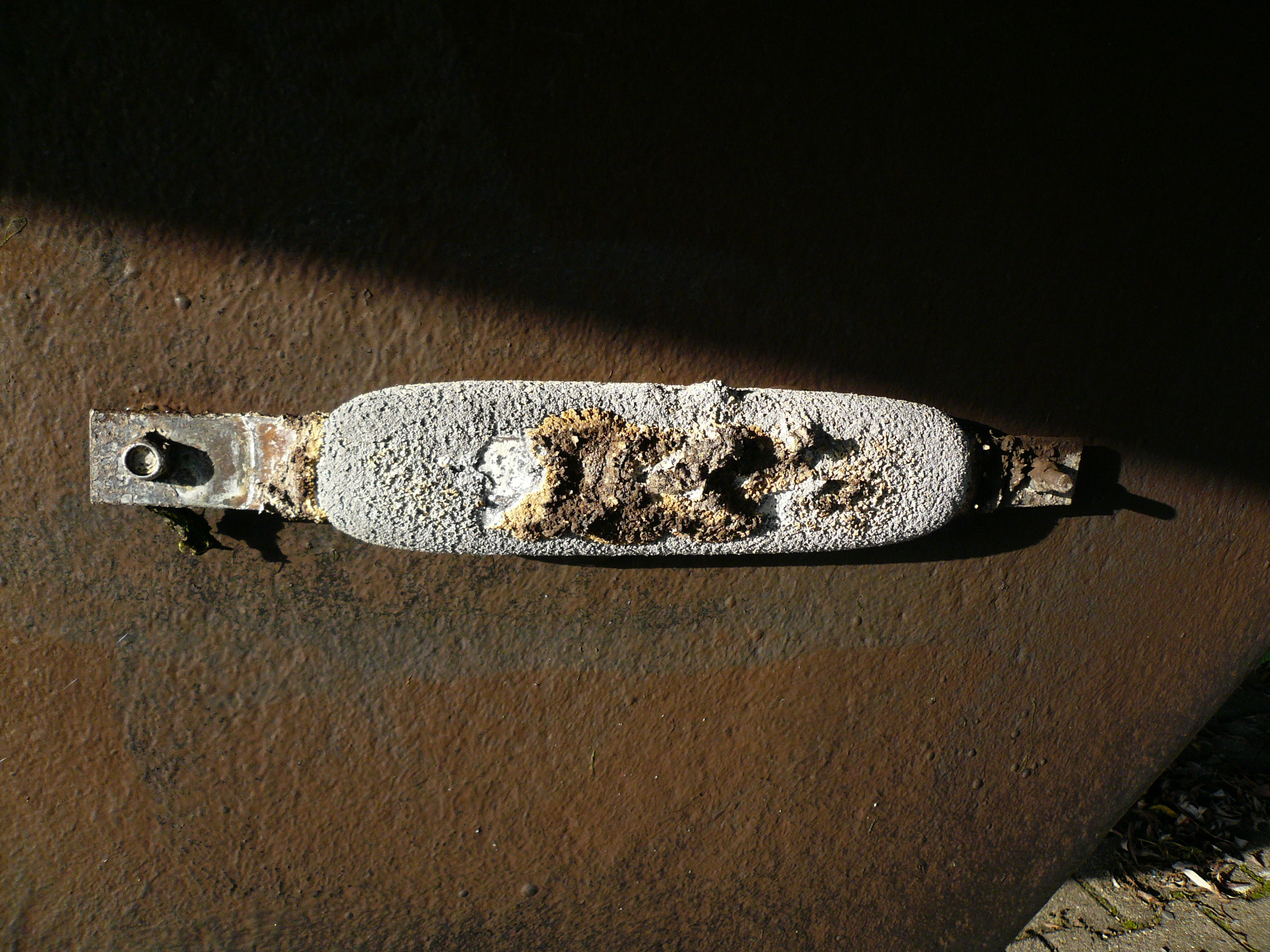
A passivated anode develops a white surface film that prevents it from reacting with seawater. The anode may look physically large and apparently unused. It is offering zero cathodic protection. Passivation most commonly affects zinc anodes in brackish or low-salinity water conditions but can occur on others. If you see a white chalky or crystalline coating on any anode surface, replace it immediately regardless of how much material appears to remain.
An anode that looks intact but carries a white surface film offers no cathodic protection at all - replace it regardless of remaining mass.
The Halo Warning Sign
A ring of pale discolouration around a bronze through-hull or fitting is a specific diagnostic sign that must not be confused with normal galvanic wear. This halo pattern indicates stray-current corrosion from a DC electrical leak - a fault in the boat's wiring using the seawater as a return path through your fittings. Adding more anodes will not stop it. The fault requires an electrical fault-finding investigation: check DC circuits, connections, and bilge conductivity. Stray-current corrosion eats metal very fast and requires a different remedy entirely.
Full Inspection Checklist at Haul-Out
- Check every anode for remaining mass - replace at or before fifty percent consumption
- Look for white surface films on any anode that appears large but barely used
- Inspect mounting surfaces for paint, antifouling, or primer between anode base and hull
- Check fasteners for looseness - a loose anode loses electrical contact with the hull
- Note any halos around through-hulls and treat them as an electrical fault-finding job, not an anode job
- Confirm the shaft anode is as close to the propeller as practicable
- Verify the propeller cap nut anode is fitted with nylon fasteners, not stainless
- Inspect trim-tab anodes if fitted - these are routinely missed

Marina Shore Power and Stray Current
Vessels plugged into marina shore power at Cairns face a problem that goes beyond their own boat's corrosion. When multiple boats connect to marina power pedestals, the AC safety grounds and bonding systems of all connected vessels become electrically linked. A yacht with fresh, active anodes is not only protecting its own metals - it may be silently protecting every neighbouring boat whose anodes are depleted or missing. Your anode budget is being consumed by boats you do not own.
The solution is a galvanic isolator fitted in the shore-power safety ground. This device blocks DC galvanic currents below the threshold at which galvanic corrosion typically occurs, while still passing AC fault current freely - meaning it does not compromise the safety function of the shore-power ground in the event of a genuine electrical fault aboard any connected vessel. A galvanic isolator is standard equipment for any liveaboard or semi-permanent marina berth holder in a dense marina environment. If you are doing a pre-departure refit in Cairns, fitting one is a more reliable long-term protection than simply shortening anode replacement intervals.
Inspection Frequency in the Tropics
ABYC standards recommend anode inspection at intervals suited to the vessel's usage and location, with anode mass sized to provide protection for at least the full period between inspections. Annual inspection - the default in most general guides - is insufficient for any vessel in a Cairns marina with active shore-power connections. Given Far North Queensland's accelerated consumption rates, marine professionals widely recommend inspections every three to six months, with the shorter end of that range as the appropriate target in a dense marina environment.
Between haul-outs, a diver inspection gives you the information you need without lifting the boat. Before any offshore passage from Cairns - whether a Torres Strait transit, a run to Bali, or a PNG cruise - a pre-departure dive is standard practice. While the diver checks the hull for biofouling and the propeller for damage, they should photograph every anode and note visible consumption, surface coating condition, and mounting integrity.
For a passage of several months where haul-out facilities may not be available at intermediate ports, carry spares as a matter of course. At ports in eastern Indonesia or remote PNG anchorages, replacement anodes of the correct specification are unlikely to be available. Carry at minimum:
- A complete set of hull plate anodes in the correct specification for your hull material
- At least one shaft anode in the correct diameter for your shaft
- A propeller cap/nut anode
- A rudder anode if your rudder stock is stainless or bronze
- A tube of zinc-oxide anti-seize compound for mounting surface preparation in the field
Fitting Anode Work into Your Cairns Pre-Passage Haul-Out
A pre-departure haul-out in Far North Queensland should treat anodes as part of the same work package as propeller, shaft, and antifouling. They are all below-waterline systems, they all require inspection at the same event, and they interact in ways that require coordination - particularly in tropical Queensland where copper-based antifouling is the standard response to heavy biofouling pressure.
Coppercoat and copper-oxide antifouling paints, commonly applied in this region, can create a galvanic cell with hull plate anodes if direct contact occurs between the antifouling and the anode mounting area. When fitting new hull plate anodes after antifouling application, the mounting zone around the anode base must be cleared to bare metal, and an epoxy barrier coat applied between the antifouling and the immediate mounting area. This prevents the antifouling itself from accelerating anode consumption - an interaction that generic anode guides written for temperate waters do not address.
The sequence of work at haul-out follows a logical order:
- Photograph all existing anodes before any work begins to record their consumption state and establish a reference baseline for future replacement intervals.
- Remove all existing anodes and inspect mounting surfaces for paint contamination, corrosion products, or loose fastener damage. Wire-brush or grind mounting areas back to bare metal.
- Inspect through-hulls, shaft, propeller, and rudder stock for any halo discolouration or unusual pitting that might indicate stray-current activity.
- Apply antifouling paint to the hull, masking off the anode mounting areas so no antifouling contacts the anode base zones.
- Apply an epoxy barrier coat to the mounting zones if copper-oxide antifouling has been applied anywhere near the anode positions.
- Fit new aluminium anodes to bare-metal mounting surfaces, tightened firmly to ensure continuous electrical contact - use nylon fasteners on the propeller cap nut anode specifically.
- Before launch, run through the full offshore location checklist: hull plates port and starboard, shaft anode, propeller cap, rudder, trim tabs if fitted, and keel bolt area if applicable.
Frequently Asked Questions
Can I use zinc anodes in Cairns instead of aluminium?
Zinc anodes will provide some protection, but they are a poor choice for Far North Queensland. Aluminium carries a significantly higher electrochemical capacity by mass, lasts considerably longer in saltwater service, and works across both brackish and full saltwater conditions - an important advantage in Trinity Inlet during the wet season. Zinc also performs less effectively in brackish conditions, which affects vessels moored in the inlet during high river-flow periods. Aluminium is the correct choice for this environment.
How do I tell if my anode has passivated rather than just worn down?
A passivated anode will carry a white, chalky, or crystalline surface film and will appear physically large - it looks as though it has barely been used. A depleted anode will be reduced in size with an irregular, pitted surface. Both conditions require immediate replacement, but passivation is the more dangerous failure because it is easily mistaken for a healthy anode with plenty of service life remaining. If any anode surface shows a white coating, replace it regardless of size.
My bronze through-hulls show a ring of pale discolouration - is that a galvanic problem?
No. That halo pattern is the signature of stray-current corrosion from a DC electrical leak somewhere in the boat's system, not a galvanic corrosion problem. Adding or upgrading anodes will not stop it. You need to trace the electrical fault - check DC wiring runs, connections, and bilge water conductivity - and eliminate the source. Stray-current corrosion works faster than galvanic corrosion and requires an electrical remedy, not a cathodic one.
Do I really need a galvanic isolator if I replace my anodes on schedule?
In a dense marina in Cairns, regular anode replacement alone is not a reliable strategy. When shore-power connections link your bonding system electrically to every other boat at the dock, your fresh anodes are working for the whole marina, not just your own metals. A galvanic isolator blocks the DC galvanic pathway through the shore-power ground while leaving the AC safety ground intact for electrical fault protection. For any vessel on a liveaboard berth or regular marina mooring in Cairns, the isolator addresses the root cause rather than compensating for it with faster anode turnover.
How far in advance before a Torres Strait or PNG passage should I inspect anodes?
A diver inspection within two to four weeks of departure is standard practice - close enough that you see actual current condition rather than a state from months earlier, with enough time to schedule a haul-out if the anodes need replacement. If your last haul-out was more than four months ago, a pre-passage dive inspection is not optional in these waters; an anode that was fifty percent consumed at haul-out may be fully depleted or passivated by the time you depart.
Can I fit replacement anodes myself at haul-out?
The fitting process itself is straightforward - remove old anodes, clean mounting surfaces to bare metal, fit new anodes with correct fasteners, and confirm firm contact. The complexity in Far North Queensland comes from the interaction with copper-oxide antifouling, which is standard in the region, where an epoxy barrier coat must separate the antifouling system from the anode mounting zones. A marine service professional with experience in this environment will handle that interface as a matter of routine. For a pre-passage haul-out before a major offshore trip, having anode work done as part of the same package as shaft, propeller, and antifouling is the most reliable approach and avoids the scheduling problem of one contractor undoing another's work.