Every offshore passage to Australia ends the same way: a protocol-driven approach to a designated port, a yellow flag at the spreader, and a wait at the dock for officers you cannot hurry. But where you choose to make that first landfall shapes everything that follows. For sailors arriving from Indonesia, Papua New Guinea, the Solomon Islands, or the wider Pacific, Cairns is the natural choice - and the clearance process there, once you understand its moving parts, is far more manageable than its reputation suggests. What follows is a complete arrival workflow, sequenced from pre-departure paperwork through to the moment the Q flag comes down and you are free to step ashore.
Why Cairns Makes Sense as Your Australian Port of Entry
Australia's Biosecurity Act requires all international vessels to enter at a designated Biosecurity First Point of Entry, and Cairns sits alongside Darwin and Bundaberg among the most frequently used designated entry ports for cruising sailors on Pacific and eastern Indonesian routes. Its position on the Far North Queensland coast places it directly in line with the main offshore routes from Bali, Ambon, and Kupang in eastern Indonesia, from the Louisiade Archipelago and Port Moresby in Papua New Guinea, and from the island chains of Vanuatu and New Caledonia. For most of those passages, Cairns is simply the logical landfall.
Practical factors matter beyond compass bearings. Since a breakwall was completed at Trinity Inlet in 2001, superyacht visits to Cairns have grown from roughly six per year to around 60 annually. That sustained traffic has made local ABF and DAFF officers efficient and familiar with the yacht arrival process. At a remote entry port, officers may need to travel specifically for your vessel; at Cairns, the clearance machine is well-established. The absence of an anchorage - Trinity Bay is exposed to swell and the dredged commercial shipping channel makes informal anchoring near the marina entrance impractical - actually works in your favour: arrivals are channelled through one place, officers know where to find you, and the process does not drag out.
| Port | Best arrival routes | Anchorage available | Officer familiarity with yachts | Onward circuit |
|---|---|---|---|---|
| Cairns | Eastern Indonesia, PNG, Pacific | No - marina berth required | High - regular traffic year-round | GBR south or Torres Strait north |
| Darwin | Western Indonesia, Cocos Keeling | Yes - Fannie Bay | High - heavy seasonal peak | East across Gulf or south |
| Bundaberg | New Caledonia, New Zealand | Limited | Moderate - seasonal peaks only | South to Whitsundays and beyond |
If your passage originates in eastern Indonesia or PNG and you intend to cruise the Whitsundays or continue south, entering at Cairns puts you at the top of a logical southward circuit rather than requiring a long passage north after clearing at Bundaberg.

The 96-Hour ABF Notice
Australian Border Force requires skippers to notify the department at least 96 hours before arrival - four full days out, regardless of your position when you reach that mark. The notification goes to the ABF non-commercial vessel email channel; check homeaffairs.gov.au for the current contact address since government channels are updated periodically. The email must include:
- Vessel name, flag, and port of registration
- Intended first Australian port (Cairns)
- Estimated date and time of arrival
- Last six ports of call in sequence with dates
- Full names, nationalities, and passport details for all crew and passengers
Keep a copy of that email and its timestamp. If your ETA shifts during the passage - common when wind patterns change or a squall alters your speed-made-good - send an updated notification as soon as you have a reliable new estimate. If the shift is more than 24 hours, send a revised email explicitly noting the change and referencing the original notification. Officers use the notified arrival time to plan attendance, and a significant unannounced shift can delay your clearance at the berth.
The DAFF Pre-Arrival Report
Separate from the ABF notice, the Department of Agriculture, Fisheries and Forestry requires its own Pre-Arrival Report (PAR) submitted through the DAFF non-commercial vessel web portal. From 27 February 2026, electronic submission became the only accepted method - the previous options of phoning or emailing the report were withdrawn. If you submit through those old channels after that date, the report will not be processed. Check daff.gov.au for the current portal link before you depart.
The submission window opens 90 days before you enter Australian territory and closes 12 hours before that point. For a Cairns arrival, Australian territory begins at the 12-nautical-mile limit off the coast. Plan the submission with comfortable margin rather than rushing it on the final approach, particularly if satellite connectivity has been unreliable during the passage.
The PAR covers several distinct areas that DAFF uses to assign a biosecurity risk level before your vessel arrives:
- Travel history - all ports visited in sequence with dates, establishing which pest and disease zones the vessel transited
- Timber components - teak decks, wooden spars, dunnage, and any raw timber on board trigger specific questions about wood-boring organisms and timber pests; vessels with significant timber will face closer scrutiny
- Biofouling management - your hull maintenance history, when the vessel was last antifouled or cleaned, and which of the three compliance pathways (see below) you are meeting
- Animals and hitchhiker organisms - cats, dogs, and any insects, barnacles, or mussel larvae observed on hull fittings or deck during the passage
- Provisions on board - fresh fruit, vegetables, meat, dairy, and other organic material present at the time of arrival
- Planned Australian ports and length of stay - where you intend to visit after Cairns
Answer every question accurately. The PAR is a legal declaration. If an inspection finds undeclared items - food in a locker, a live insect in the bilge, undisclosed timber - it is treated as a biosecurity violation, not an oversight.
The 2026 Biofouling Management Rules
From 18 June 2026, every non-commercial vessel arriving in Australia must demonstrate biofouling compliance through one of three pathways. DAFF uses the PAR and accompanying documentation to assess risk level before the vessel arrives, and that assessment determines what happens at the clearance berth. The three options are:
- A DAFF-approved biofouling management plan - a written plan documenting your antifouling regime, inspection schedule, and maintenance history, submitted and approved through the DAFF portal before arrival; this pathway requires preparation months in advance, not days
- Documentary proof of hull clean within 30 days before arrival - an invoice and record from a licensed haul-out facility or commercial diving contractor, showing the vessel name, the date, and the scope of work performed
- A pre-approved alternative management method - a DAFF-defined alternative for which an application must be submitted at least 30 days before arrival in Australian territorial seas; it cannot be arranged on arrival
Vessels assessed as high or extreme risk face mandatory hull inspection on arrival, which may include required treatment or a management activity before the vessel can leave the clearance berth. A vessel arriving after a long passage in tropical waters with no recent haul-out and no management plan is a strong candidate for that classification.
Getting a haul-out and antifouling job completed in the final month before your Australian departure is the single most effective step you can take to arrive in the low-risk category - the invoice from that yard, showing the vessel name and date, is straightforward evidence that requires no pre-approval process and clears the most common biofouling trigger cleanly.
For practical purposes, pathway two is the most accessible option for most offshore cruisers. Haul out in Bali, Kupang, or Port Moresby, keep the paperwork, and carry it with you. A record from a yard showing the vessel was cleaned and antifouled within 30 days of your Australian arrival date satisfies the rule without any interaction with the pre-approval system.
What Food Survives the Biosecurity Inspection - and What Does Not
The prohibited categories
Australia's biosecurity rules on food are broad and consistently enforced. On arrival, DAFF officers inspect the galley, all food storage lockers, the rubbish bins, and any biological material on deck. The following are prohibited biosecurity items that must be declared and will typically be seized:
- All fresh fruit and vegetables, regardless of variety or origin
- Meat in any form - fresh, frozen, dried, cured, or smoked
- Dairy products and eggs
- Unprocessed animal products including honey from non-approved sources, beeswax, and feathers
- Seeds, nuts, and plant material that is not commercially heat-processed and sealed
- Any food showing signs of insect activity or mould
What generally passes
Commercially sealed, factory-manufactured shelf-stable products - tinned goods, dried pasta, UHT milk in sealed cartons, sealed breakfast cereals - generally clear inspection without issue. Packaging must be factory-sealed and the product commercially manufactured rather than home-prepared or home-preserved. Keep the original packaging. If a specific item is uncertain, check daff.gov.au before departure; conditions vary by country of origin and the list is updated.
Galley management before arrival
Treat the final week of the passage as your consumption window. Work through fresh produce in the galley, cook down vegetables, use the meat stores, finish the fruit. What you cannot eat can be disposed of overboard while still in international waters - not into Trinity Inlet or any Australian waters. Whatever reaches the clearance berth either passes inspection or is surrendered as biosecurity waste, which DAFF disposes of at no cost or penalty to the skipper. You face no consequence for declaring and surrendering food. You face potential prosecution for failing to declare it.
Travelling with Pets
The DAFF import permit for cats and dogs is not a simple form. It requires:
- ISO-standard microchipping of the animal before any vaccinations are given
- A full rabies vaccination course followed by a blood titre test showing adequate antibody levels
- Treatment for external and internal parasites within a defined window before departure
- A veterinary health certificate issued within a specified period before the voyage begins
- A mandatory quarantine period on arrival in Australia, the duration of which depends on the country of origin
The 180-day waiting period required by Australia begins from the date the laboratory receives the blood sample, not from the initial vaccination date - so the total process from microchipping and first vaccination to meeting this timing requirement typically runs well beyond six months in most departure countries. That means the permit preparation process needs to begin roughly a year before your planned arrival - not the month before departure. Check daff.gov.au for the specific protocol applicable to your country of origin, as treatment requirements and quarantine lengths vary significantly.
For cats: DAFF has noted that it is practically impossible to import a cat to Australia by sea except from New Zealand. The combination of permitted source countries, quarantine requirements, treatment protocols, and sea voyage conditions creates a set of constraints that very few situations meet. Sailors with cats who are planning a Pacific circuit and considering ending it in Australia should research this honestly before leaving New Zealand rather than discovering the reality on the approach to Cairns.
Q Flag Up: the Approach to Cairns Marlin Marina
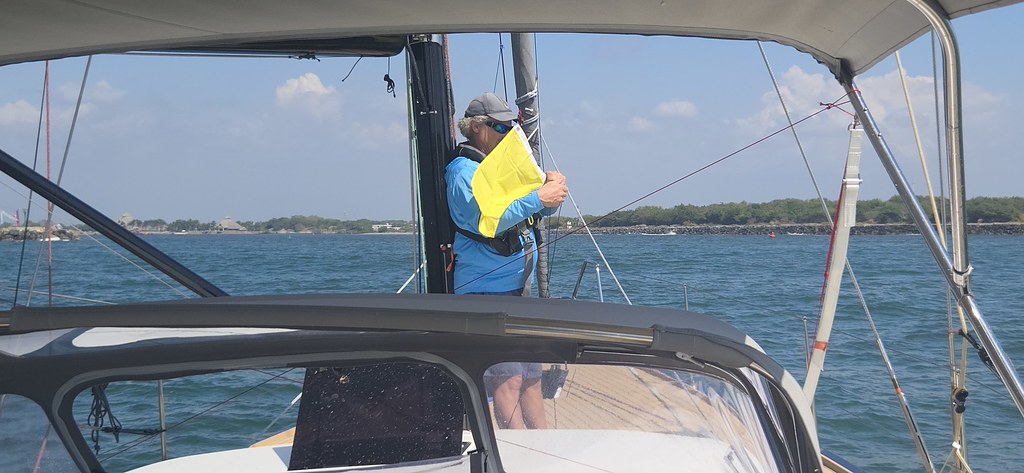
The Q flag - a solid yellow square - goes up at the starboard spreader the moment you enter Australian territorial waters at 12nm. This is a legal requirement under the Biosecurity Act, not a tradition. It stays flying until DAFF grants pratique. The sequence from that point is fixed:
- Hoist the Q flag at the starboard spreader and proceed directly toward Cairns Marlin Marina
- Contact Cairns Marlin Marina on VHF to confirm berth availability at the clearance station
- Berth at 'A' finger - the designated customs boarding station at the marina on Trinity Inlet
- Remain aboard - no crew member or passenger steps onto the dock or ashore under any circumstances
- ABF officers board and process crew immigration: passports, Crew Report, Ship Pre-Arrival Report, Crew Effects Declarations, Ship's Particulars, Ports of Call list, and Stores List
- DAFF officers conduct the biosecurity inspection: galley, food lockers, rubbish, bilge, deck, timber components, and hull risk assessment
- When both agencies are satisfied, DAFF grants pratique - the Q flag comes down and the crew is free to go ashore
Have all documents organised before officers arrive. The full ABF document set is: Crew Report (Customs Form 3), Ship Pre-Arrival Report (Customs Form 13), Crew Effects Declaration for each person on board (Customs Form b465), Ship's Particulars, Ports of Call list covering the last six ports, and Stores List (Customs Form 5-4). Add to that your biofouling documentation, all passports and ship's papers, and any pet import permits if applicable. A straightforward clearance on a weekday morning typically takes two to four hours from first contact to pratique.
Fees, Timing, and the Weekend Arrival Option
DAFF charges for non-commercial vessel biosecurity inspections through a structure that includes a base vessel arrival fee plus a per-quarter-hour charge for inspection time. Arrivals outside ordinary weekday business hours - evenings, weekends, and public holidays - attract after-hours surcharges on top of those base charges. Check daff.gov.au for the current fee schedule; the specific rates are updated periodically and any figure from a third-party source, including this article, may be stale by the time you read it.
The practical upshot is straightforward: arriving on a weekday morning costs meaningfully less than arriving on a Saturday afternoon. If you have any flexibility over your ETA in the final day or two of the passage - sailing slightly slower, heaving to for a few hours overnight - use that flexibility to target a Monday-to-Friday morning arrival.
The weekend phone clearance option
If a weekend or after-hours arrival is unavoidable, Cairns has a practical procedure. The skipper can call DAFF biosecurity to initiate a phone clearance for the crew. Officers take declarations by phone and confirm answers by email, allowing the crew to remain on the vessel overnight without a full inspection team attending that evening. The hull and galley inspection is then scheduled for the next business day. Three constraints apply: the vessel stays alongside the clearance berth, the Q flag stays up, and no one goes ashore until the full inspection is complete. This is not a shortcut around the biosecurity process - it is a legitimate procedure designed to prevent crews from being held on board in deteriorating conditions simply because they arrived on a Saturday. Knowing this option exists also removes the temptation to push an arrival into Wednesday night in order to "make" a Thursday-morning slot when a Friday morning would be both safer and cleaner.
From Cleared to Cruising
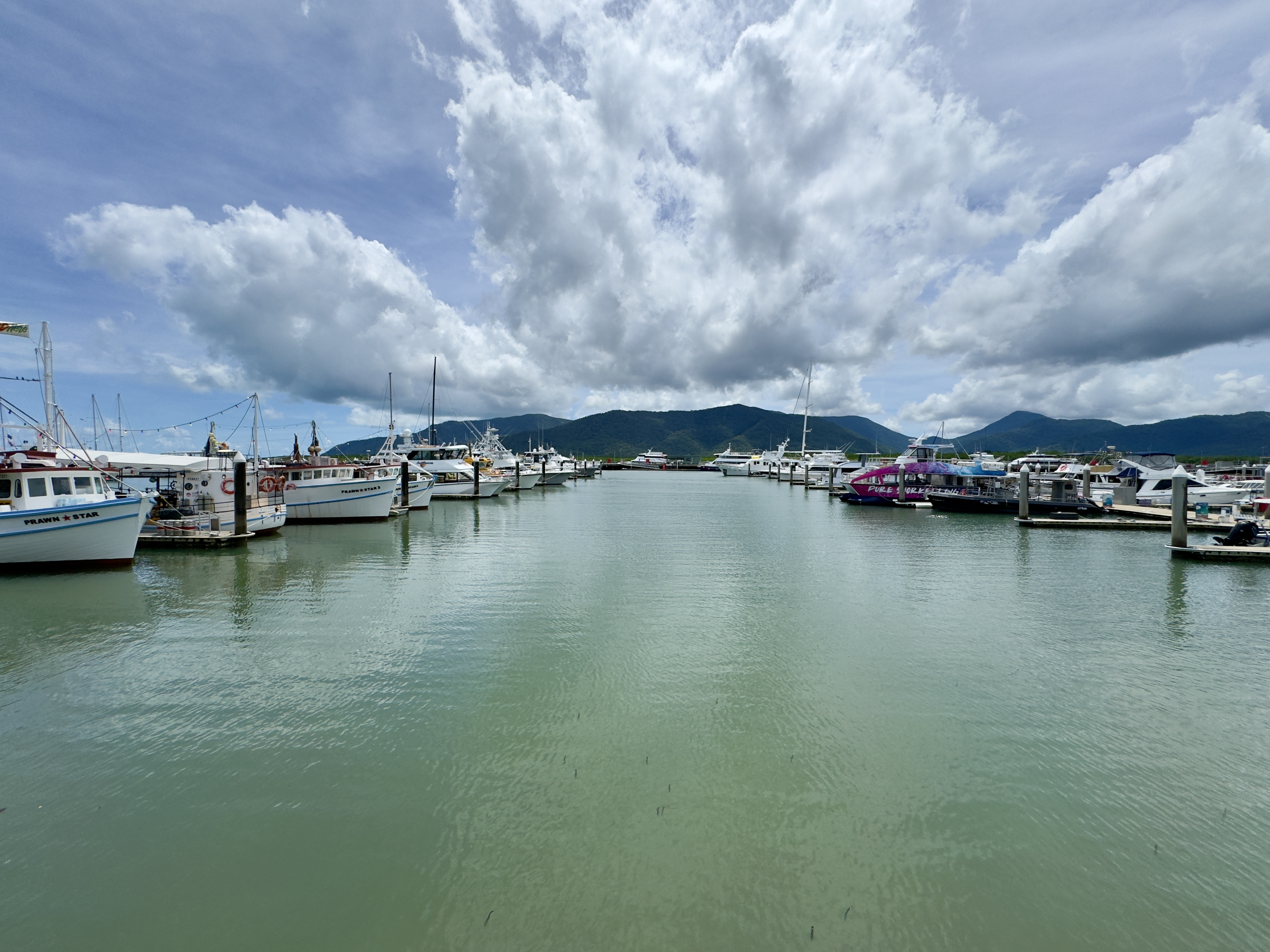
Once pratique is granted, the marina transitions from a clearance requirement to a working base. The facility accommodates a wide range of vessel sizes - from sailing yachts on floating pontoons to larger motor yachts and superyachts on the fixed-structure Sailfish Quay wharf - with a dredged channel that handles deep-draft vessels. Most arriving crews find several tasks converging in the first days alongside, and the Cairns precinct handles all of them without the vessel needing to move:
- Reprovisioning - supermarkets and a fresh produce market are accessible from the marina precinct; after weeks of managing reduced Pacific provisions, a full reprovisioning run is usually the first order of business
- Maintenance and refit - riggers, diesel mechanics, canvas makers, marine electricians, and electronics specialists all operate in or near the marina; haul-out facilities are available for structural and antifouling work
- Crew changes - Cairns Airport is less than ten minutes from the marina and handles direct international flights to multiple hubs; for crew joining or leaving mid-voyage, Cairns is one of the most accessible exchange points on the Australian coast
- Immigration administration - crew who arrived on visitor visas need to confirm their conditions and permitted activities; crew changes require documentation with ABF
- Passage planning - whether the next leg is south through the Whitsundays, north through Torres Strait toward Darwin or Southeast Asia, or offshore to Japan or the Pacific, the weeks after clearance are the right window to plan and prepare